| LatchKey.ai | Archive | About | Consulting | Forward |

Issue #8: Second Verse — Same As The First
The pattern is familiar. Can you recognize the vibes?
click to view full-size
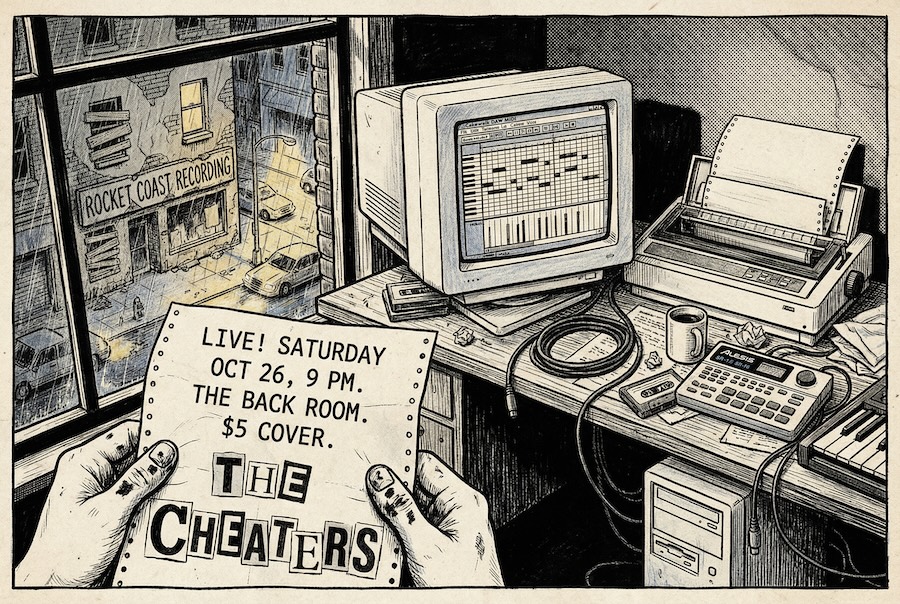
In 1992, I was a struggling musician playing in bands around LA. Back then, there was no "online." No Spotify. No streaming. No MP3s. The only path to fame and fortune was getting signed to a record label. And unless you were hitting up your friend's cousin, whose aunt was neighbors with a guy who was the podiatrist of an executive at Capitol Records, the only way to get the attention of a label was with a well-produced demo... and even then, the podiatrist might not take your call.
But studio time was expensive. You needed an engineer. Tape was expensive. Mistakes were expensive. Paying by the hour made time your enemy. It was extremely gate-kept.
Then the world shifted. Desktop computers really took hold, and the Tiger Direct catalogs became aspirational. Soon, the ambitious DIY tinkerers among us realized that the gate standing closed between us and our dreams was nothing but an expensive analog lie.
With the new PCs came new tools: MIDI sequencers, Digital Audio Workstations, and Virtual Instruments. If you were willing to vibe your way through a mail-order parts catalog, use a screwdriver, and overclock an Intel Celeron 300A processor, you could bypass those gatekeepers entirely on the back of a Sound Blaster Live! audio card, a 6GB hard drive and a stack of Zip Disks that made it all seem infinite.
Those early insurmountable barriers to success, the analog gate-keepers in their big expensive studios, were left standing alone. Many scoffed at these new tools. "Cheating!" they called it.
If everyone can record music with no technical training we will be flooded by endless garbage!!
That resistance to change closed studios and ended careers.
But those that chose to adapt broke new creative ground and forged entirely new sonic categories to explore. No one called it cheating once the hits started coming.
The professionals that embraced the transition were unbothered by the idea of a growing pool of competition. They knew the tools were always just the means to facilitate their true value — their taste. Knowing what a good mix sounded like and how to achieve it didn’t change. Their medium changed. Their craft evolved. Their art expanded.
Their judgment stayed.
By 1998 I had redirected enough ‘studio time’ money into buying gear, that I effectively had my own small but functional recording "studio" in the second bedroom of my apartment.
That little bedroom studio changed the trajectory of my life.
The intention, of course, was to solve my own problem and record my music. But in fairly short order something weird happened, I got…clients? And they weren’t recording music. Most covered a range of other audio jobs. Voiceover work. Radio spots. Sound design for video games and animation. Telephone on-hold systems.
Within a year it was my full-time job.
When desktop PCs finally had enough processing power to support desktop video editing, I learned those tools too, and expanded my business. Eventually that work led to larger video production jobs, and ultimately to my career at NASA/JPL.
The new technology had democratized creative expression and cultivated career opportunities. And I was a direct beneficiary.
But mine wasn’t even the first verse of this song.
In the early 1980s, a career in publishing required specialized prepress and typesetting skills mainly taught through apprenticeship.
Then one day in 1985, a Macintosh, a LaserWriter and PageMaker walked into a bar...
Suddenly anyone with those three tools could call themselves a publisher. The ensuing tsunami of undisciplined content that followed was its own slop era. Lots of "ransom note" vibes. Church bulletins heaped with 14 different fonts across a single page of blue text on pine green or purple paper, and…is that a picture of Susan’s baby at the bottom or a Rorschach test?
Pre-1985 there were roughly 70,000 professional graphic designers in the country. A craft skill requiring expertise in paste-up boards, X-acto knife work, and Rubylith. It was real physical labor.
Fifteen years later there were more than 200,000 graphic designers and exponentially more work available to them, using tools like Illustrator and Photoshop. No boards. No knives. They couldn't measure in picas or hand-spec type, but they could wield a bezier pen tool inside computer software, and build a life.
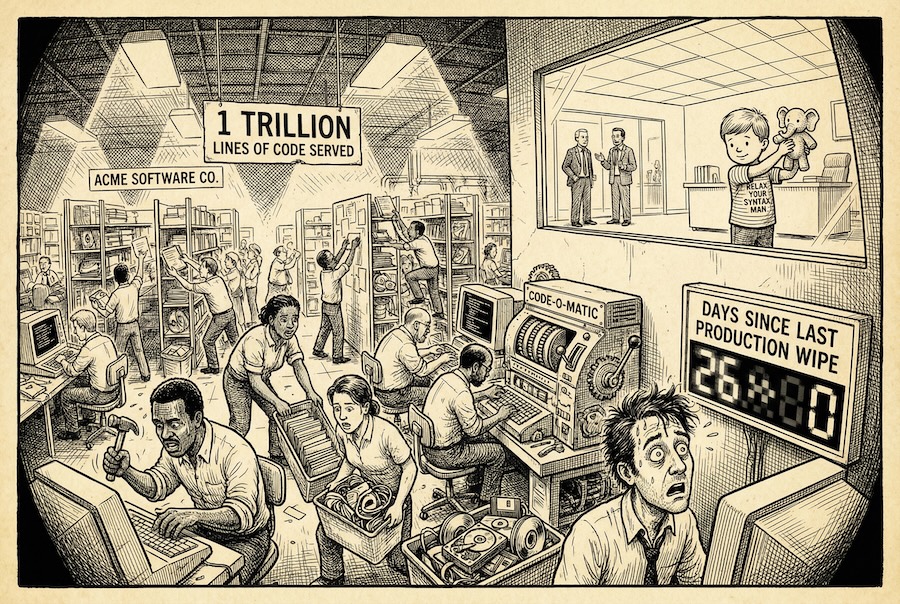
Today, AI has ignited this same kind of gravitational shift inside the software industry itself.
Over the past year, the sector that has seen the fastest rise in professional AI adoption has been software development — the people who can write code from scratch. In little more than a year they've gone from AI tools that improved their coding speed through ‘smart code-completion’, to letting the AI write all of their code. Not because they can't do it themselves, but because it no longer made operational sense.
AI has turned coding by hand into typesetting in 1986. A waste of time.
And the reason why it's moving faster through software than every other domain AI is touching now, is because of verifiable outcomes. Code is deterministic. It either works or it doesn't.
When you ask AI to draft an email or generate a report, "good" is subjective. When you ask it to build a login page, you click the button and you either get logged in or you don't. That immediate, unambiguous feedback loop is why the coding industry has so easily handed their work over to AI. The builder can tell immediately whether the output is right.
The professionals doing this don't consider it cheating. They consider it obvious. Today, the largest AI companies project nearly 100% of their internal code will be written by AI this year.
But here's the nutty thing. Even the companies using AI to write nearly all of their code are still hiring new engineers. The creator of Anthropic's Claude Code, Boris Cherny, said "someone still has to prompt the agents, talk to customers, coordinate across teams, and decide what to build next."
Google Cloud AI Director Addy Osmani followed: "When AI handles the code generation, the engineer's value shifts to the decisions above the code: what do we build? why? for whom? and how it all fits together. The bottleneck was always judgment, taste, and systems thinking. AI just made that more obvious."

Vibe coding MenuGen (Andrej Karpathy): Karpathy actually built an app with it and wrote honestly about what happened.
Vibe Coding and Other Ways AI Is Changing Who Can Build Apps (Microsoft Source): Microsoft's engineering leaders on the shift from 'how to code' to 'what to build.'
The Synthesizer: A Blessing or a Curse? (BBC Archive, 1983): Peter Gabriel debates a futurist who calls the synthesizer "cheating."
808: The Drum Machine That Changed Music Forever (Twenty Thousand Hertz): The Roland TR-808 was a commercial failure. “Pros” rejected its fake drum sounds. Then hip-hop producers picked it.
How Outsiders Become Game Changers (Harvard Business Review): Problem-solvers six degrees removed from a challenge domain were three times more likely to solve it.
Ira Glass on The Taste Gap (The Marginalian): "All of us who do creative work get into it because we have good taste." When the tools change, taste is what survives.
click to view full-size
Old habits die hard
The rapid reorientation of how software gets built has caused a new tension in the dev world. Around process.
Traditional software development is a deeply compartmentalized affair. Teams of specialists each focus on different pieces. Designers hand off to front-end developers who hand off to back-end developers who hand off to testers. Very few people in the process ever see the whole elephant. The role that does see the big picture — the Product Manager — spends most of their time keeping everyone aligned on a shared vision while fending off scope creep.
If you've ever managed a complex project with multiple contributors who each see only their contribution, you already understand the fundamental challenge of building software.
The coordination was always the hard part. The code was just the medium. And the most expensive line item in the budget.
So when advanced AI coding tools made their way out of traditional development environments and into the hands of curious normies like me in the Spring of 2025, it was suddenly the 90s PC era all over again. An army of untrained bedroom devs quickly emerged and started churning out software on their own terms and by their own rules. This rattled many pros.
"Cheating!" they called it.
If everyone can build software with no technical training we will be flooded by endless garbage!!
When anyone can use natural language to describe a software-shaped idea and then watch the equivalent of days or weeks of human coding materialize in mere minutes, for pennies… it becomes clear that conversation is the new code.
OpenAI co-founder Andrej Karpathy dubbed this new workflow "Vibe-Coding" — describing it as "fully giving in to the vibes, embracing exponentials, and forgetting that the code even exists."
Here's what makes the story about more than just disruption.
Psychologists call it the Einstellung Effect: when an expert's successful past solutions prevent them from seeing a more creative approach to a new problem. Experienced coders are habituated to syntax-first thinking — manual optimization, memory management, code readability. With AI tools, many struggle to let go, spending excessive time reviewing every line or trying to compete with the AI on typing speed. It tugs against a lifetime of training and instinct.
A non-coder, by contrast, arrives with beginner's mind. Unconstrained by adhering to legacy processes or how things worked in the past, they simply focus on clearly describing the desired outcome. And as AI drops the cost of coding to almost zero, the risk of failing on your first…or fourteenth try, is meaningless.
That turns out to be fertile ground for creative innovation.
Of course, like those mid-90s bedroom recording studios that did indeed churn out lots of unlistenable crimes against music, we are seeing a steady rise in half-baked software efforts flooding the internet. But that’s because a fundamental constant in technology-enabled creativity has always been garbage in, garbage out.
Over time, the serious bedroom producers picked up the fundamentals of recording engineering, merged them into their pioneering spirit, and reinvented the music industry.
The same potential exists with vibe-coding. As folks absorb the value and practice of good planning, testing, iterating, and attention to security, we will see an explosion of truly innovative creative software solutions.
It's already happening. A burgeoning group of solo founders and professionals is building functional applications without traditional training — "small, sharp tools" designed to solve a specific problem for themselves, but they end up finding takers. Kinda like my little bedroom studio did.
Justin Lai, an educational technologist, used Claude to build a Plywood Cutting Visualizer app that calculates and displays exactly how to cut a sheet of plywood with minimal scrap. Very simple. Very niche. But it solved a direct practical need he had and, it turns out, others did too.
Sarah sells jewelry but didn’t like the rules and fees and frustrations of the big platform shopping sites. So she ‘vibed up’ a custom e-commerce app that included a photo gallery, checkout process, and messaging system. She focused her attention on improving the customer experience instead of learning how to manage a database. Because the AI can do that part for her.
Alfred Megally built MIXCARD, an application that turns Spotify playlists into physical postcards. Do you need this? I don't need this. But Alfred wanted it, and now he has it.
These people didn’t arrive at software through a computer science degree. They arrived through a problem they wanted to solve. And the lens their lived experience brought to the work — educator, retailer, music fan — turned out to be a differentiating asset, not a liability.
I arrived through the lens of a producer.
Thirty years of media production taught me a workflow that I never imagined was transferable to software. I know pre-production, production, post-production. I know how to sit with ten hours of raw interviews and find the right three-minute story, how to kill your darlings to keep the pace, and that everything looks better with the right music.
Discovering that a smart software development workflow required scoping the project, planning the structure, building in passes, reviewing, refining, and shipping — but didn't require knowing how to code — well, the rest felt very familiar.
What surprised me more, though, was how alien this approach felt to traditional developers. They were rattled by people like me skipping straight to a working prototype and iterating from there. The idea of building the whole thing rough, then refining instead of carefully laying one brick at a time, was unnerving for them. But to me, that's just how producers have always worked. You get the shape of the thing first, then you sculpt.
So I kept building. Recently I built myself a virtual office manager. And a few other things. Next week, we will walk through exactly how I did it.
But here's the question that matters more than anything I built for myself:
What do you need? What bottleneck or pain point have you just accepted as an unfortunate drag on your work? If you stopped to think about it, could it be solved with a custom automation or a simple tool?
If you could, what would you build?
## Try This: The Specification

You don't need to build anything this week. Instead you should try to reprogram your own attention.

Over the next few days, notice the moments where you work around something instead of through it. It can be anything.

The workaround is the tell.

Every time you copy data between two apps, reformat the same report by hand, or manually check something that should just tell you — that's a gap where software could live. You've been stepping over these friction points so long they've become invisible.

Keep a running list. Phone notes, sticky note on your desk, whatever works. When you catch yourself in the act, jot down one line: what were you doing, and what got in the way?

That's it. No specification. No chatbot. Just observation.

Next week, we'll take one of those moments and turn it into something real.
Hey Look! A Reader Poll!
Which AI tool is your daily driver?
Quote to Steal:
"In the beginner's mind there are many possibilities, but in the expert's mind there are few."
Thanks for reading,
-Ep
Miss any past issues? Find them here: CTRL-ALT-ADAPT Archive
Got a friend who's great at managing projects but thinks building software isn't for them? Forward this.
Did this newsletter find you? If you liked what you read and want to join the conversation, CTRL-ALT-ADAPT is a weekly newsletter for experienced professionals navigating AI without the hype. Subscribe here —>latchkey.ai