click to view full-size
Setting the Pace
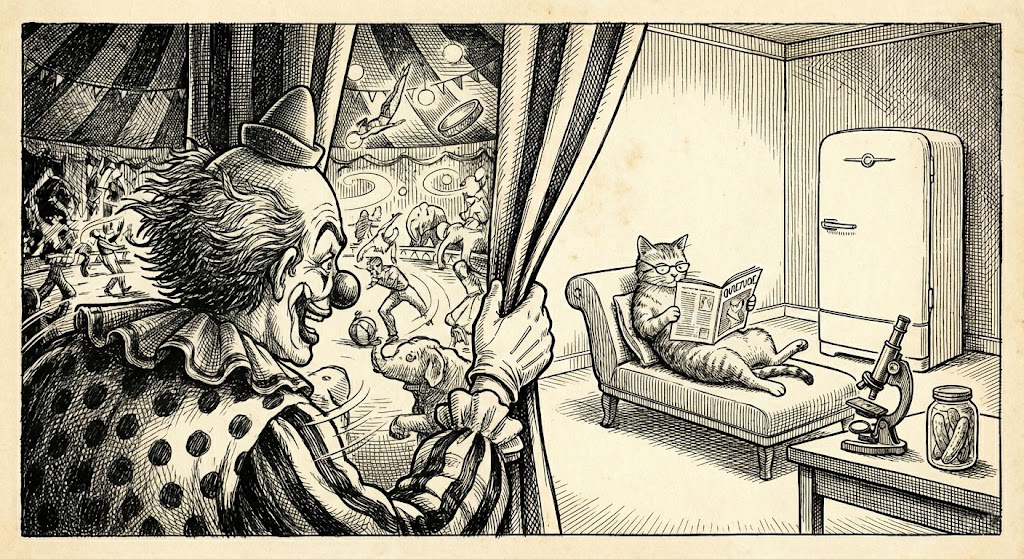
In the last issue, we mucked through the slop. That torrent of AI-generated vapidity quickly making the phrase 'artificial intelligence' scandalous in mixed company (and heretical among the under 30s). The carnival of high-resolution digital garbage.
We recalled how in the 1400s, the printing press, the world’s first 'generative' engine, terrified the elite because it could flood the world with unvetted ideas. Today, we are having that same 'printing press' argument about deepfakes and artistic theft.
But while the world continues to churn the ethical butter around if and what AI should make, Vision AI is quietly churning up a revolution around what AI can see.
Let’s talk about it.
Our garage refrigerator has been running since the first Bush administration.
Not the second one. The Dana Carvey one.
A couple of weeks ago, one of the door shelves finally had enough. That adjustable plastic thing that holds the condiments, but everyone sees as the ‘inside’ handle they can pull to close the door. It decided it was done with that job and cracked in half, instantly dropping a jar of pickles onto a six-pack of LaCroix. A minor domestic catastrophe.
Was it me pulling it shut by the shelf? Maybe. But listen, this isn’t about me.
Normally a thing like this would mean my afternoon was sacrificed to squinting at a fridge model badge faded from years of wear, Googling seventeen variations of those last few numbers that have worn off completely, and eventually giving up because life is short and the pickles can live in the crisper drawer.
But we know nothing is normal anymore. So I pulled out my phone, wrenched my arm to the back of the fridge and took a shaky picture of that dilapidated model badge.
Then I popped the pic into my Gemini app.
"I need a replacement for the adjustable door shelf. What's the part number, and where can I find one?"
A few seconds later I had the model number confirmed, and the exact part number for that obtuse piece of molded plastic meant to hold my pickles. Three retailers with it in stock. The part arrived last Thursday.
I could have asked ChatGPT to write me a poem about refrigerators. I could’ve had DALL-E generate a picture of what my fridge might look like if it were from Narnia. Both would have taken my mind off the broken door shelf for a time.
Instead I asked Gemini to read a half-obliterated sticker from 1999, and discern its every detail.
Spectacle? Or Spectacles?
In 1590, Hans and Zacharias Janssen, two Dutch lens-makers, put a couple pieces of glass in a tube, looked through it, and (boing!) invented the microscope. They changed the world without making anything new at all. They didn’t 'create' bacteria or cells; they just gave humans the resolution required to finally see what had been hiding in plain sight for millennia.
Now consider for a second the way microscopy changed the destiny of every man, woman, and child to live in the wake of that discovery. And yet even today most people never touch a microscope outside of their high school biology class.
Stewart Brand, the Long Now Foundation visionary, has a framework for how complex systems absorb shocks: pace layering. Civilization operates in layers—from the frothy fast layers of fashion and commerce to the steady slow layers of infrastructure and culture. "Fast gets all our attention," Brand writes. "Slow has all the power."
Generative AI lives in the fast layer. It's fashion—quick, engaging, self-preoccupied, and (Brand's word) cruel. "Try this! No, try this!" It's culture cut free to experiment as irresponsibly as society can bear. That's its job. The spectacle is supposed to be a spectacle.
Vision AI lives in the slow layer. It's infrastructure—reading faded serial numbers, spotting anomalies in X-rays, catching structural cracks before bridges fail. No viral videos. No trending topics. Just quietly accumulating capability while the fast layer grabs headlines.
Brand's insight was that healthy systems need both. Fast innovates; slow stabilizes. Fast proposes; slow disposes. The apparent contradiction between them is precisely where the system finds its health.
We know how history has a tendency to rhyme.
In 1959, two researchers at Johns Hopkins were trying to understand how vision works. For hours they showed a comfortably sedated cat complex shapes while monitoring its brain activity. Nothing. Silence. Then, while sliding a new glass plate into the projector, the edge of the glass cast a sharp line across the screen, and the monitors lit up like a pinball machine. The discovery was, the brain doesn't see shapes first. It sees edges. The contrast where one thing ends and another begins. That accidental discovery became the blueprint for neural networks, which eventually led to the development of modern Vision AI systems.
Today, while Generative AI is busy making high-resolution fictions, Vision AI is busy making sense of low-resolution realities, quietly re-scoping the course of all our lives and settling in as a pillar of the future economy. One is cultural spectacle, the other is culture’s spectacles.
Vision AI is our generation’s microscope.
click to view full-size
Pace Layering: How Complex Systems Learn (MIT Journal of Design and Science) — Stewart Brand's framework: "Fast gets all our attention, slow has all the power." The circus is fast. The infrastructure is slow.
Be My Eyes: How AI Is Transforming Accessibility (App) — Vision AI describing the world to people who can't see it. The quiet revolution, quietly changing lives.
The Practical Implementation of AI Technologies in Medicine (Nature Medicine, 2019) — The research behind vision models as diagnostic partners, not replacements.
Phone-Powered AI Spots Sick Plants With Remarkable Accuracy (Wired, 2019) — The people who feed us, making decisions with information they couldn't access before.
click to view full-size
The Doors of Perception
Once you see the pattern of possibility with VisionAI, the doors start opening.
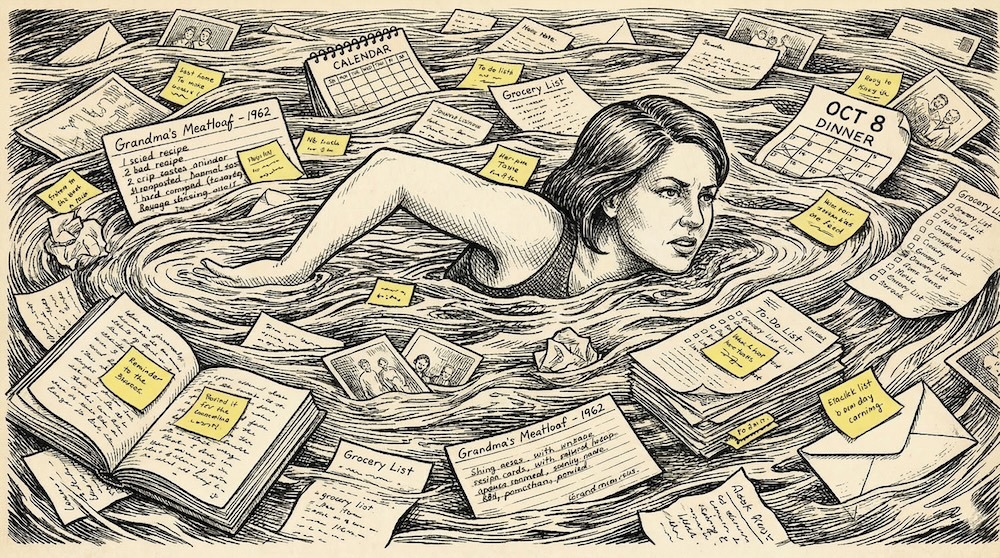
My wife is a deeply analog soul. Her world is anchored by the wall calendar she keeps in her home office. Handwritten. Every soccer practice, every doctor's appointment, every birthday party for kids whose names I will never remember. But sometimes that analog vibe runs into digital demand.
I might get a phone call in the middle of the day, “Can you check the calendar and tell me if October 8th is the day I marked for dinner with Barney and Betty?”
”uh..I will when I get home. I’ll text you.”
When I got home I took a photo of the entire month of October. November and December, too. I asked Gemini to extract every event with dates and format them for Google Calendar import. Three minutes. Done. I added all of it to mine… and hers. But I don’t think she’s looked there yet.
What about that collage of post-it notes on the desk by the kitchen? Or stuck to the side of your monitor like barnacles on a ship?
Photo —> transcribe —> organize by theme —> Export to Docs. They're searchable now.
Grandma's recipe cards from 1962, written in a script that hasn't been taught in schools since the Nixon administration. Vision AI doesn't care that her "t" looks like an "l" and her measurements are vibes. It reads them anyway.
You came home from that conference with forty business cards and Covid. Photo → “Extract contacts, with company and context.” No more mystery rectangles in your desk drawer.
"I forgot who gave us this bottle of wine. Someone spendy enough that it might be worth saving for a special occasion, or should we just drink it on Taco Tuesday?" Point, shoot, know.
The possibilities are endless. Because in truth, we all spend our lives swimming in a soup of our own unstructured data. Bits and pieces floating around us all the time, everywhere. AI excels at quickly and easily structuring that data into searchable information you can actually use.
But these simple personal use cases are just the ground floor.
The Ladder: Where This Goes
If Vision AI can read my faded refrigerator badge, what else can it read that humans can't—or can't fast enough?
In radiology departments, vision models are working alongside specialists to identify patterns in X-rays, MRIs, and pathology slides that human eyes miss. Not replacing radiologists, but giving them a second set of eyes that never gets tired, never loses focus after the tenth consecutive scan. Early detection rates for certain cancers are climbing.
Farmers are pointing cameras at crops and getting disease identification before symptoms are visible to the naked eye. Satellite imagery analyzed by vision models can predict yield issues across thousands of acres in the time it used to take to walk a single field. The people who feed us are making decisions with information they couldn't access five years ago. This is the kind of technological progress that could help stabilize the impact of climate change on our food supply.
For the vision impaired, apps like Be My Eyes are using Vision AI to describe the world—reading medication labels, identifying currency, navigating unfamiliar spaces. The technology becomes eyes for those who need them, turning smartphones into tools of independence.
On factory floors, quality control that used to require human inspectors staring at conveyor belts for eight-hour shifts is now handled by vision systems that catch defects humans would miss after hour three. One study showed a 38% improvement in defect detection. However, it is important to note that the inspector's job didn't disappear; it shifted from being responsible for catching every flaw (impossible), to focusing seasoned human judgement on identifying edge cases and anomalies.
Biologists are using vision models to classify species from camera trap images. Astronomers are analyzing telescope data for patterns that would take human researchers decades to review manually. Archaeologists are reconstructing damaged texts from fragments that scholars had declared unreadable.
Like Generative AI, it would be naive not to acknowledge the dark side of Vision AI. The same technology that helps radiologists save more lives can also be deployed for surveillance that threatens liberty. The same systems that give independence to people with visual impairments can track faces in crowds, monitor behavior, and erode privacy at scale. These concerns aren't hypothetical; they're happening now, and the regulatory frameworks are still years behind the deployment. We are at a crossroads where the same 'eyes' that monitor a crowd can also cure a disease. Our job is to figure out how to keep the breakthroughs without letting it break us.
In the meantime, where do you see opportunity for Vision AI?
What information is locked in your world, your industry, your community or your daily work? What knowledge could be unlocked if you could just see it better? What decisions could you make if the hidden patterns were made visible?
The infrastructure is being built. The circus will move on. What gets built in the quiet that follows, is up to us.
### TRY THIS: The Vision Test

*Time: 10 minutes | Tools: Gemini, ChatGPT or Claude*

---

**Step 1:** Find something with your handwriting on it.

A cluster of Post-it notes. A whiteboard. Pages from a journal you haven't opened in forever.

**Step 2:** Take a photo.

**Step 3:** Upload it to ChatGPT, Claude, or Gemini.

Ask the AI:

> "What does this say?"
>

Then ask it to **organize** what it found. **Summarize** it. Turn it into **action items**.

*There is data trapped all around you, just waiting to be useful.*

*Leaving it there just wouldn't be prudent.*
Quote to Steal:
"If the doors of perception were cleansed every thing would appear to man as it is, infinite."
Thanks for reading,
-Ep
Miss any past issues? Find them here: CTRL-ALT-ADAPT Archive
Know someone who hasn't heard what AI can see? Forward this. It'll make sense.
Did this newsletter find you? If you liked what you read and want to join the conversation, CTRL-ALT-ADAPT is a weekly newsletter for experienced professionals navigating AI without the hype. Subscribe here —>latchkey.ai