click to view full-size
I first saw the internet in 1992.
My friend took me to his dad's den, fired up what was probably a Tandy 1000 or maybe a Compaq Presario, and logged into Prodigy Online. I was gobsmacked. I understood it immediately.
A couple years later, my college roommate had a PC with a modem. Back in those days we still frequented actual bookstores for interesting reading and next to DOS for Dummies I found an almost magazine-thin book called, The Internet Yellow Pages that claimed to have “The Most Complete Listing” of websites that existed. “All Addresses Fully Verified!”
Half of them went nowhere. The rest were mainly university research sites, so I kept looking.
You wouldn’t have found “official” company websites back then. No one but us nerds even knew the World Wide Web had just been born. But I needed a show pony. Something to demonstrate this thing to my family and friends.
And, oh boy. I found what I needed. …Otter Pops.
Back home for Christmas that year I made it my mission to gather folks round the IBM PS/2, crank up the 14.4 kbps modem and punch the URL into my shiny new Netscape v1 browser.
And then we would all stand transfixed…for at least two minutes… watching the page crawl in, line by line. But then!? Vivid color images of all six flavors of America’s favorite stick-less popsicle, the Otter Pop, side-by-side across the screen. 🤯
And then I'd say: "Go on. Click on one of them."
"What?"
"Yeah, click on a picture."
They'd flash a quick look of confusion and then cautiously click. The screen would go blank. We'd watch another two minute crawl. And then there it was: a close-up of the Otter Pop flavor they'd selected.
That was the whole site. That was the future. I felt like an Oracle.

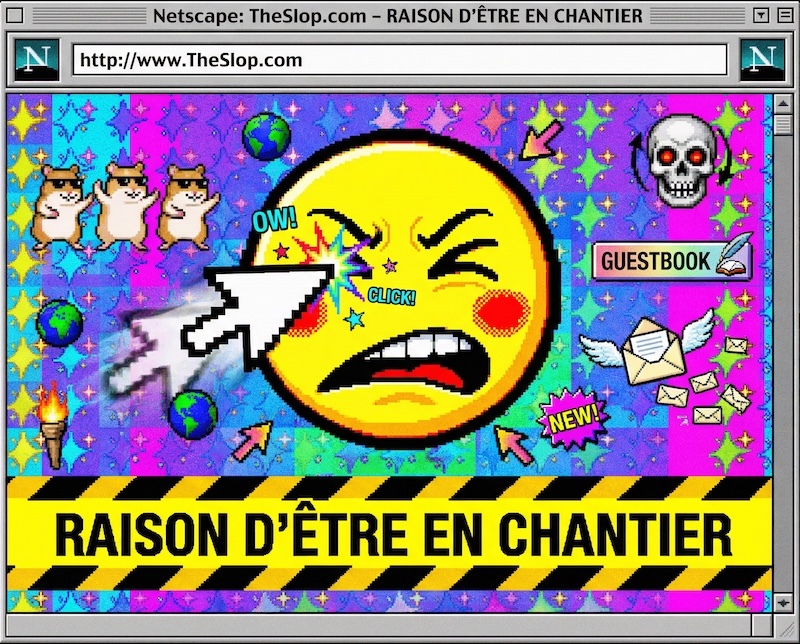
And just a few years later, we were all drowning in dancing hamsters and abandoned GeoCities shrines.
We reached the peak in January 2000 when Pets.com, a company so confident in the future of online pet supply retail that they spent $1.2 million on a Super Bowl ad, catapulted their sock-puppet mascot to momentary cultural icon status. Nine months later, the company was dead. Stock price: from $14 to 19 cents.
When the dot-com bubble burst, the verdict seemed clear: the internet was a fad made mostly of noise.
Except... it wasn't.
Yes, the noise - the slop - was real. The bubble was real. But they weren't the thing. They were just the carnival phase—the predictable chaos that surrounds every genuinely transformative technology before the world figures out what it's actually for.
Even then we'd seen this movie before. Literally.
In January 1896, the Lumière brothers screened one of the first motion pictures: L'Arrivée d'un train en gare de La Ciotat. Fifty seconds of a train pulling into a station. No story. No characters. Just the gimmick of moving pictures! So sensational was it, that a lore developed claiming audiences screamed and fled during screenings, thinking the train was real. (Historians now doubt that happened, but the legend persists because it feels true.)
The response from serious people? Antoine Lumière, father of the inventors, reportedly warned a buyer: "My sons' invention can be exploited for a certain time as a scientific curiosity, but apart from that it has no commercial future."
Six years later, Georges Méliès made A Trip to the Moon, the first narrative film with special effects. The gimmick had become an art form. Twenty years after that, cinema had become the dominant storytelling medium of the twentieth century—supplanting books.
Speaking of books, four hundred years before the Lumières, a Dominican friar named Filippo de Strata warned that the printing press would corrupt civilization. Cheap books flooding the market. Ideas spreading without proper gatekeepers. The scribal tradition, and the church's control over knowledge, under existential threat.
The printing press survived its critics.
The Otter Pops website wasn't the internet.
And the slop isn't AI.
🖋️ "The pen is a virgin; the printing press is a whore."
click to view full-size
The Great Otter Pop Protest of '96 (Portable Press): A fourth-grader discovered the company was discontinuing his favorite flavors. He organized a protest, appeared on Jay Leno, and the company backed down.
Where the Media Critics Went Wrong (American Heritage, 1988): In the 1950s, serious critics predicted television would produce mass conformity, passive obedience, and intellectual decay. Then the 1960s happened.
Chaos in the Airwaves (WSHU): In the early 1920s, anyone could broadcast on any frequency they wanted. The result was predictable, and the label on early radios might as well have read "MAYHEM“. The slop era of radio.
Theodore Sturgeon: In His Own Words (Library of America) video: Regarded as one of the godfathers of contemporary science fiction and dark fantasy, Sturgeon pushed back against societal conformity, leaving a legacy of works that were light-years ahead of their time.
click to view full-size
The universal base rate of noise
In 1953, science fiction writer Theodore Sturgeon was tired of critics dismissing his entire genre based on its worst examples. His response: "Ninety percent of science fiction is crud. But then, ninety percent of everything is crud, and it's the ten percent that isn't crud that is important." Dubbed ‘Sturgeon’s Law’, philosopher Daniel Dennett later championed it as a critical thinking tool applicable to physics, chemistry, sociology, medicine …everything.
The deepfakes. The infinite gallery of celebrities with seven fingers. The confidently wrong chatbots. The artistic "theft" debates. The Pets.com of AI, whatever that turns out to be, is almost certainly already funded and running Super Bowl ads this year.
This is what's filling your feed. This is what's filling your friends' perceptions. This is why your millennial coworker or Gen Z kid rolls their eyes when AI comes up.
They're not wrong to be skeptical. They're reacting to what they've seen. What their social media feed has told them AI is.
But here's what our brains haven't caught up to yet: AI generates at such high resolution that it fools us into taking it seriously. Look at the detail on that AI-generated image! Listen to how fluent that chatbot sounds!
Detail isn't quality. Resolution isn't legitimacy.
Ask ChatGPT to write a 900-page novel about the fall of Rome. It will. And it will be the most impressively boring book you've ever skimmed. Every sentence technically correct. Every paragraph utterly lifeless.
That's because right now generative AI output is all logic and no soul. It lacks intent. It lacks a reason to exist. It lacks a point of view that gives it purpose. It’s a live microphone in the middle of a room where everyone who walks by either just blows in it or says, “Is this thing on?” We all hear it. We can’t help but hear it. But it’s meaningless.
Until someone with something meaningful to say finally steps up.
The technology doesn't know what's worth making. You do. The gap between "impressive-looking garbage" and "genuinely useful output" is entirely bridged by human judgment.
By someone who knows what they want and why they want it.
Which brings us to the uncomfortable middle ground: the legitimate concerns around Generative AI.
Appropriating recognizable artistic styles without consent. Using people's likenesses to say things they never said. The copyright questions that remain genuinely unresolved. These aren't hysteria. They're real problems that deserve real legal frameworks.
But the bad actors shouldn't indict the whole technology. They should inform the regulations.
We figured this out before as well.
When sampling emerged in hip-hop, early examples were straight theft. Artists lifted entire hooks without clearance. In 1991, a judge literally opened his opinion with "Thou shalt not steal."
The sampling free-for-all ended. Sampling didn't.
🎵 "Hiphop is a predatory art form—and over the years—has more and more become a bastion of musical cannibalism."
Like cinema a hundred years before, it matured into something more than a legitimate art form. It reshaped culture entirely. And for more than two decades now, the new songs you love are almost certainly built on sampling technique so sophisticated you don't even notice. And the artists who are sampled get compensated.
Image generation is in its pre-1991 moment.
The art-style appropriation. The likeness abuse. The training data questions. These are real. They need real legal frameworks. And they'll get them the same way sampling got them.
The technology isn't the problem. The application of it is what should be judged.
You can use a chainsaw to carve a sculpture or to terrorize a summer camp. The chainsaw doesn't care.
📷 "If photography is allowed to supplement art in some of its functions, it will soon have supplanted or corrupted it altogether."
The critics railing against generative slop aren't wrong about the garbage. They're wrong about the trajectory.
The carnival doesn't last forever. The rules catch up. The technology finds its footing.
The question is how you will use it when it does.
Next week, we explore what's happening behind the carnival already.
## Try This ## : The Reality Remix

*Time: 10 minutes | Tools: Gemini or ChatGPT  (Claude doesn’t generate images)*

---

How many hours have you spent doom-scrolling Pinterest looking for inspiration? You find 50 photos that *sort of* feel right, but none of them are *your* breakfast nook. None of them are *your* backyard.

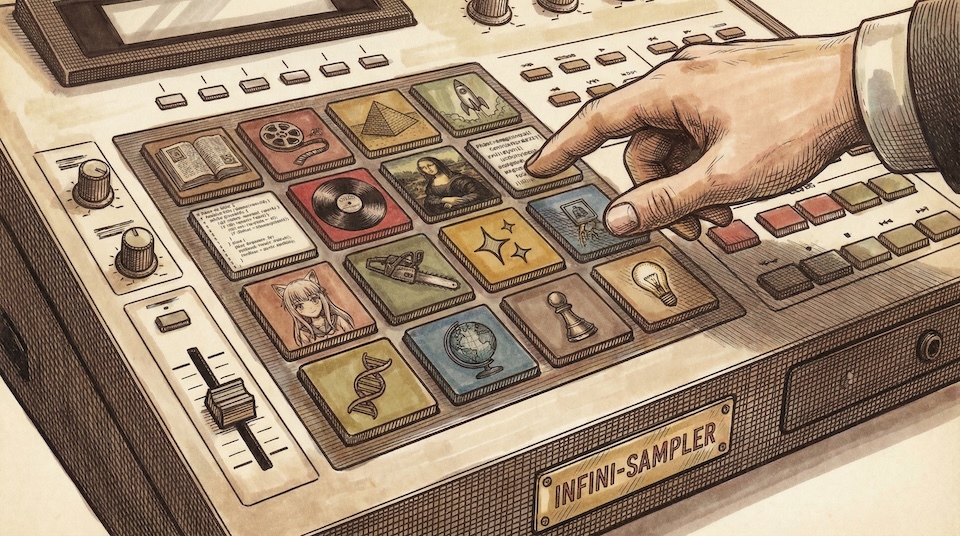
We're going to use AI like a hip-hop producer uses a sample. Take a photo of your actual space. Remix it.

**Step 1: The Sample**

Grab your phone and head to that room you hate, or that part of the yard you're ignoring and take a picture. Or, if you're feeling brave, take a selfie.

**Step 2: The Remix**

Upload the photo to your chat app. Tell the AI what to change *and* what to keep:

> "I want to redecorate this room. Keep the window and floor where they are, but make that back wall a burgundy accent. Change the curtains to wooden shutters, and add a leather armchair in the corner. Don’t change the lighting. Make it realistic."
>

**Step 3: The Iteration**

The first image won't be perfect. The AI might hallucinate a lamp. That's fine. This is a concept sketch, not a blueprint. Talk back: "Too dark. make it a lighter red." or "White shutters, not brown.  …and remove the lamp."

**The Diagnostic**

You’ll see it. Does that wall color work or not? Do the gravel and fire-pit change the yard dynamics?  Does the tousled bixie cut make you look like a rockstar or a chaotic aunt?

*You just turned the "slop" machine into a tool for personal clarity.*
Thanks for reading,
-Ep
Know someone still wrestling with their feelings about AI? Forward this. At least it’s food for thought.
Miss any past issues? Find them here: CTRL-ALT-ADAPT Archive
Did this newsletter find you? If you liked what you read and want to join the conversation, CTRL-ALT-ADAPT is a weekly newsletter for experienced professionals navigating AI without the hype. Subscribe here —>latchkey.ai