| LatchKey.ai | Archive | About | Consulting | Forward |

Issue #25: Intermission
click to view full-size
The report card on a two-year experiment, a word about pitchforks, and why the house lights are coming up for a bit.
In December of 2024, I started an experiment with a simple question: can AI enable one person to build and operate a solo business at the altitude it historically would have required five to ten people to reach?
Twenty-five issues and multiple business engagements later, I can report the answer. It is 100% yes.
But the truth of it is something a little more nuanced, and if you have been along for this newsletter ride from the start, or we talk outside of this venue, you’ve already heard me refer to it: responsible AI use requires a lot of user discipline. Understanding when and where NOT to use AI matters every bit as much as knowing when to reach for it.
The pitchfork stage of the operation
Two years into the AI technology revolution, we all see the internet drowning in unabashed slop, frenzied commentary about slop, rage-bait slop commentary masquerading as earnest concern about the slop... and all of it in a near vacuum of coherent, rational explanation of the technology itself.
The frontier AI companies are among the worst offenders, with whatever contributions they have made to the reasoned conversation getting drowned out by their own hyperbolic marketing fabulism and a peculiar unwillingness to push back on even the most irrational accusations and predictions about their tech. Choosing instead to use it all as more bait for the venture capital feeding frenzy that has defined ‘the land-rush phase’ of AI the past few years.
The mad scramble to secure market position and enshrine their own vision for domain dominance has been a clinic in commercial chaos. Whether it’s OpenAI recklessly chasing a Meta/Facebook-shaped business model by focusing on cheap generative gimmickry and trying every conceivable way to wedge advertising into the user experience, or Anthropic following the Microsoft model of capturing enterprise business at all costs, including at the expense of the average consumer, or Google injecting Gemini AI into every ubiquitous surface we’d all forgotten leads back to a single corporate source. It’s all happened so fast, with so little explanation.
No wonder so many people are so freaked out.
Those who never saw it coming, or have yet to really wrap their heads around it, have nowhere to turn for answers beyond their social media and news feeds. And I can tell you, from the random scary posts your cousin forwards you courtesy of [email protected], to the New York Times technology section, no one is really getting the story right. Not with any consistency.
The incentive to just post lazy reporting, edited down to the scariest clickbait possible, is proving a goldmine for a media ill-equipped to keep up with the unprecedented pace of change in AI. The result is that the only story that stands still long enough for them to notice is ‘the concern’. So that is what they write about over and over and over, content with this compromise between revenue and ‘truthiness’.
But the result has been to cultivate a backlash to AI that has curdled into something just as lazy.
Listen, by now you should know that I am not a grandstander. No AI companies are paying me to defend them. Because I don’t. I am the first to agree that there are legitimate concerns that need to be properly addressed about the future of this technology, but most of them have more to do with who controls it and who makes money from it than about the technology itself.
Exactly the same as nearly every other ‘technology’ we rage at.
You don’t hate electricity. You hate your electric company. You don’t hate cellular telephony. You hate your cell phone company. You don’t hate your smartphone. You hate the garbage it pumps into your face like a bilge pump every time you open it. Because it’s always the greed, never the tech.
The machines continue to have no opinion.
Most of what circulates about AI in the media today is misinformation. Full stop. Because it is so new and so different from everything that has ever come in the door dressed as technology before, there is no easier way to make money off of it than to generate fear around it. And that has brewed a public backlash like no technology has ever seen.
Of course, the other significant differentiator is that no ground-shifting technology like this has ever landed in a reality so totally shaped by social media feeds before. And like every other social media hot-button, people’s positions and opinions on AI have largely hardened into one-dimensional reactionary reflexes.
Two stories from the last few weeks to demonstrate exactly where we are.
A debut novelist named Jerry Falade sold his crime novel for north of two million dollars after fourteen publishing houses fought over it at auction. Fourteen! Whatever else you want to say, the market read that book and loved it. The experts all agreed that it could make them money, which is what they are in the publishing business to do.
Weeks later the deal was dead. Not because anyone demonstrated the book was bad, and not because anyone had proved AI wrote it. Falade’s own literary agents pulled it, out of what appeared to be fear for their own credibility. They were “no longer able to authenticate how the manuscript fully evolved from origin to completion,” is what they said.
The evidence against Falade amounted to style-sniffing. According to reports, his prose supposedly carried “hallmarks of AI.” The author had freely admitted he used AI in his research. Why not? It is exceptional at that. Look how good it helped make his book! But now, a manuscript fourteen publishers wanted will not exist, because nobody could produce a certificate of unassisted origin. <scratches head> Uh...was the book good? Did people like it? What else really matters here?
It’s got a bit of a “papers, please!” vibe, no?
Hank Green is one of YouTube’s original self-made successes. He and his brother were among the pioneers of the platform as it evolved from what could arguably be called its own ‘slop era’: the mid-2000s heyday of “Charlie bit my finger,” Chocolate Rain, and “Leave Britney Alone,” when random nobodies uploaded every dumb idea and pointless clip to their channels because the novelty of the tech was so compelling.
Hank became a YouTube star because of the integrity of his content. He is an educator. He is a thoughtful explainer of science and engineering and all manner of interesting topics for curious minds. A creator who helped set the bar for how good YouTube can actually be. He’s not about slop. He’s not MrBeast (ask your kids). And Hank deservedly built a huge and loyal following from his work.
Hank has never offended anyone.
Then, a few weeks back, Hank used the phrase “I appreciate the pushback” in a video on his own network. Ok, so what, right? Well, some anxious viewers decided the sentence ‘sounded like something AI would say’ and they took to the comments section with both fists. Within days Hank’s routine conversational pleasantry had metastasized into a full-blown scandal. A man who has been writing his own scripts since before some of his accusers could read was suddenly under attack by a mob on suspicion of <shudder> secretly using AI to write his scripts.
Of course, anyone who has both watched Hank’s work and explored having AI write for them would easily recognize that it could never write what Hank actually speaks.
But here’s the part that really hit me like a brick: faced with an accusation this hollow, what did Hank choose to do? Hank, the guy who built his career on patiently translating technical complexity for young people? He first ‘admitted’ that he had been using ChatGPT for research assistance and that, for a guy running a multiple-channel YouTube operation based on intelligent content, it had been a real productivity booster on that front. But then... he apologized. A full public mea culpa.
Hank is a smart guy. He can feel the temperature of the public around this topic, especially the white-hot activist rage among his core Gen Z audience. “Mortified,” he said. He ‘promised to do better’. He announced he would pause projects.
He performed penance for the crime of using a research tool efficiently. An innocent man confessing to witchcraft because the trial looked worse than the sentence.
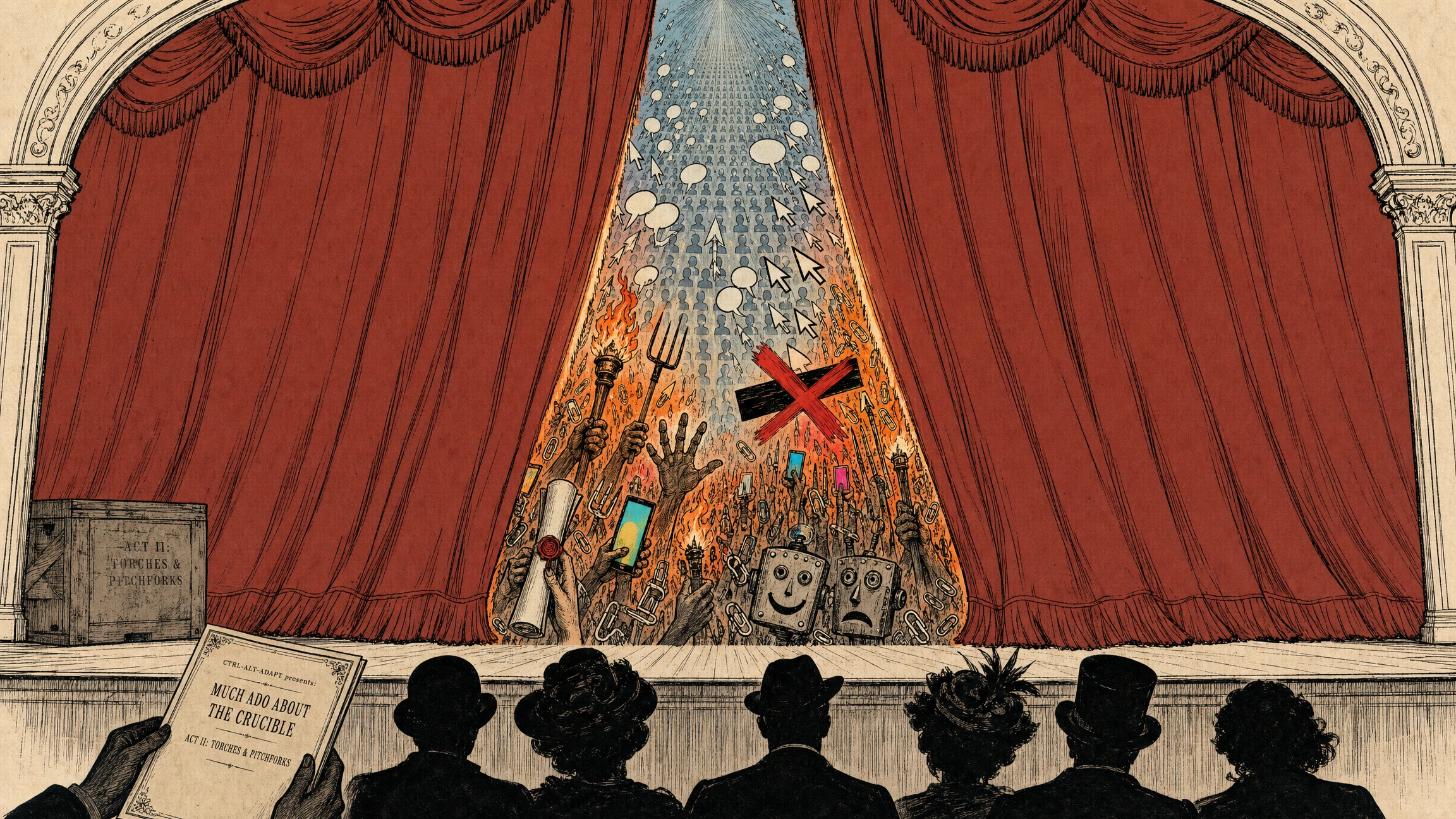
We have reached the pitchforks-and-torches stage of the operation, folks. And the mob doing the judging is as deeply misinformed as their witch-hunting forebears.
Not uneducated, mis-educated about the technology they fear by the technology that already owns their attention. An industry of opportunistic agendas making massive amounts of money by perpetuating that fear. And almost certainly helped along by a considerable assist from America’s adversaries.
The fears have been manufactured by misinformation in the absence of real information. The result, and I will say this plainly, is that the mob now worries me far more than the AI does.
And then there is the poor little em-dash — that elegant little horizontal gesture that real writers have loved for two centuries — which the mob has been taught is now the fingerprint of the machine. Spot one — just one — and the verdict is in: no human wrote this!!
I have a confession, and it might be more embarrassing than Hank’s. Months ago, I quietly banned the em-dash from my own house style — a punctuation mark with real sophisticated utility — because I could see the pitchforks coming and decided the proper and legitimate use of a centuries-old bit of ubiquitous typography wasn’t worth the suspicion it now ignites. Think about that. Writers are now pre-emptively hiding their punctuation — burying the family silver in the yard — so the neighbors don’t report them for sorcery. But today I am choosing to wear my em-dashes like jewelry. Consider it civil disobedience — and consider how badly things have drifted when using a dash requires courage.
I have made no secret that I use AI in producing this newsletter. It was kind of the original point of launching it. I have leaned on the process as a teaching example in several issues, quite on purpose. To many, that means I must have the AI write for me.
While the big AI companies, and the zillions of startups trying to ride their coattails, woo enterprise whales on the promise of endless mundane task automations to streamline their widget factories and prove their value to the investment class, I believe today, as I did nearly two years ago, the most powerful role AI can have for us is as a thinking partner. The thrill of an inspiring collaboration with an egoless partner who listens intently to all of your ideas, and then cracks them open and explains them back to you in ways you would have never considered. Sometimes smashing them to shards on the rocky shores of your own hubris. It is extraordinary.
There is also a real story to tell about the way this technology supports and enables ADHD brains and other divergent neurotypes that have struggled for decades to reach their potential in a world that wasn’t designed for them. And I have barely scratched the surface on that topic in these pages. It might take a whole book.
And yet: every word printed in every issue of this newsletter has gone out the door with my complete sense of ownership of its authorship. I write the newsletter.
And that takes time. A lot of it.
From ideation, through research and analysis, through drafting and finishing, through conceiving and designing and generating the images, to final layout and publishing, this newsletter is the single biggest consumer of my time in any two-week period.
Could I automate a lot of it? I could automate all of it. But I have no desire to. It would lose my voice. It would stop being the direct expression of my ideas, and you would feel it.
And it wouldn’t be nearly as fun.
Meanwhile, my notes from the wings
The AI landscape continues to move at the breakneck pace I pointed at back in January. We have seen the end of the chatbot era begin, and the era of agents and long-running workflows move in. We have gone from everyone sharing images of themselves hugging their younger selves to death threats and body bags left at the doorstep of the people who made that possible.
My own consulting has shifted under this climate as people have grown uneasy openly endorsing AI use. What began as a focus on helping individuals learn the tool basics and gain an on-ramp to more complex AI collaborations has shifted largely to integrating systems and building custom tools for businesses. And it’s worth noting that the client profile is often the same person. It just feels somehow safer to engage as a business decision than a personal one.
But the bottom line is that the experiment worked. LatchKey AI today is a live business with more moving parts than any one person could have ever run alone in the past.
And among the many lessons hiding inside that success, the most illuminating one is this: I am the bottleneck.
AI is an amazing tool, so malleable and so capable that “tool” often feels insufficient as a description. But as I have said here over and over, it does not replace us. Human judgment and insight are irreplaceable when we actually care enough about our work to insist on a continuity of standard for its excellence. If that judgment can’t be reliably delegated, then we, the human operators, become the bottleneck on AI’s productivity.
My judgment is now the scarcest resource in my business. And the newsletter demands a share of it that would force the parts of the business that actually earn my living to wait in line.
That’s not a complaint. It’s a conclusion. The data supports it.
And so: intermission
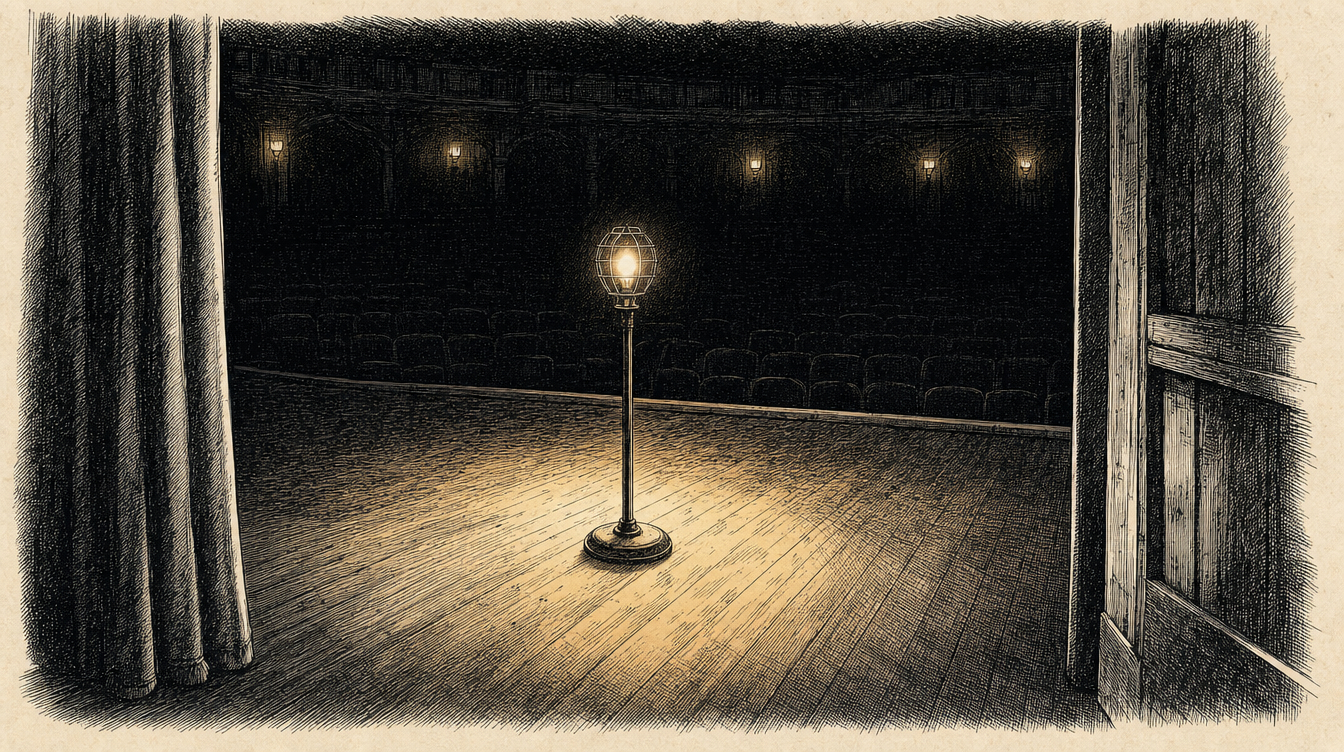
I still have a lot to say about AI, and I have ideas brewing about what happens to the newsletter from here, but I need a little room to get deeper into the R&D and hash it out amidst the rest of LatchKey’s moving parts. So the first season of CTRL-ALT-ADAPT ends here, at Issue #25, and the house lights come up for a while.
To be clear: the channel stays open. I am still on the other end of these words, reachable with as little as a reply to this issue.
I am also certainly available for consulting, for speaking, for business engagements, all of it. And don’t be surprised if the occasional missive lands in your inbox during the intermission. Maybe an update or an announcement. Maybe just some strong feelings about something in the news. You know how I get.
Before we head to the lobby: a couple of announcements
It’s Still Early is now in print. My book is live on Amazon in paperback: get it here.
If this newsletter has ever handed you the right frame at the right moment, the book is that, bound and gift-able, for the smart people in your life who just aren’t super technical, and don’t need to be.
They’re the ones who can benefit the most from learning AI.

Follow along between issues: There is a CTRL-ALT-ADAPT Facebook page you can follow, and my LinkedIn. Both will stay warm during the intermission.
And the direct line: [email protected] reaches me anytime, for anything. All of these channels are open.
Twenty-five issues ago, I told you it was still early, and twenty-five issues later I believe it still is. I am excited to see where the future takes us, and I plan to talk about all of it with you at the next curtain.
click to view full-size
Thanks for reading,
-Ep
Miss any past issues? Find them here: CTRL-ALT-ADAPT Archive
Know someone still stuck in the AI lobby? Forward this. Help them find a good seat.
Did this newsletter find you? If you liked what you read and want to join the conversation, CTRL-ALT-ADAPT is a weekly newsletter for experienced professionals navigating AI without the hype. Subscribe here —>latchkey.ai