| LatchKey.ai | Archive | About | Consulting | Forward |

Issue #24: Show Me
Lead Line:
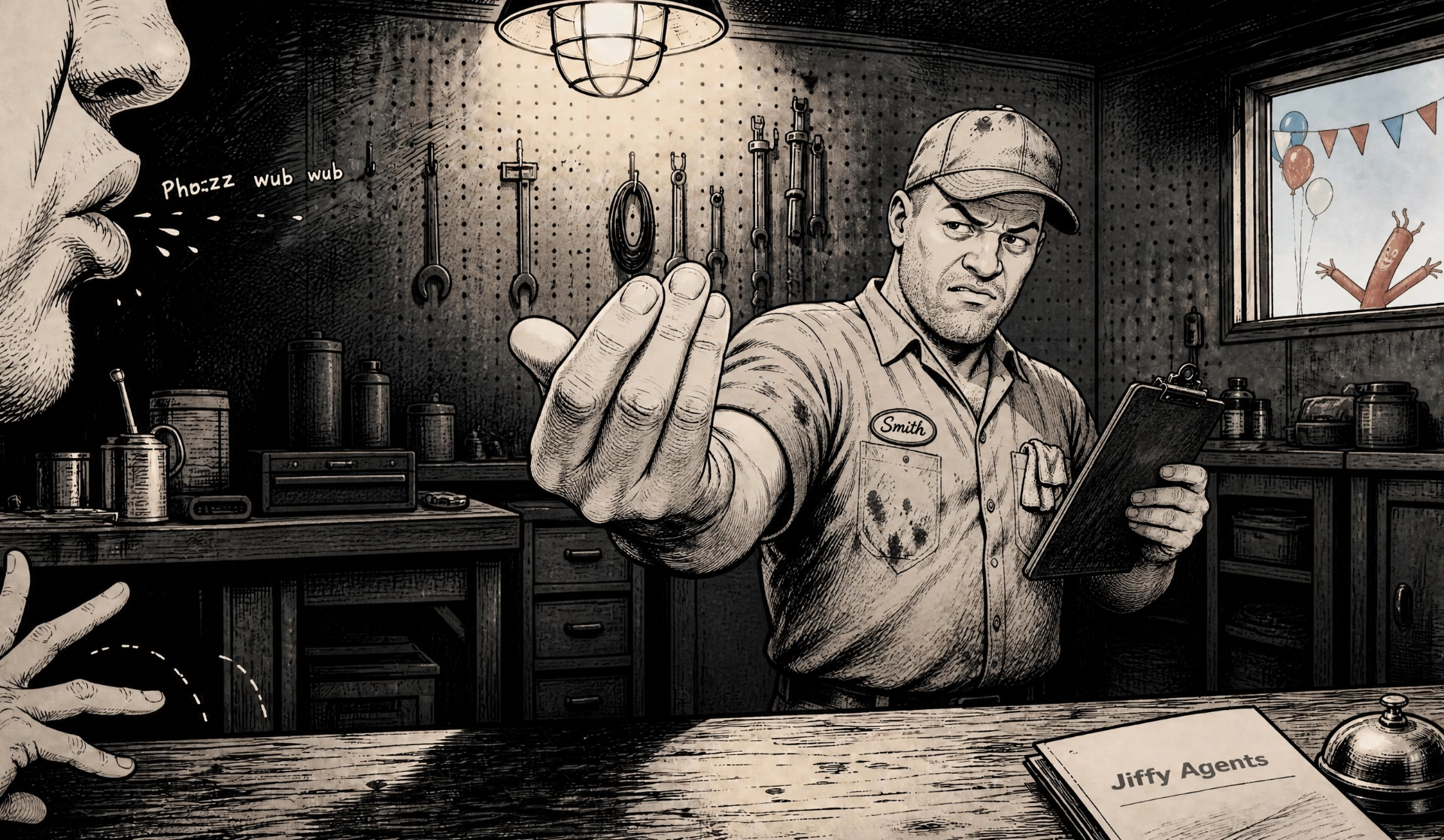
For the majority of us who aren’t ‘car people’, the dumbest we ever feel in our lives is at the service counter of the mechanic. Yeah, we know things. We’re not stupid. It’s the deeper anatomy, though. So we stand there and make ridiculous mouth noises at a professional because we cannot explain in words what our own cars need.
“It’s like a wub-wub-wub thumpida! that sharpens into a clack! clack! grzzz-ity-clack! when I brake.”
We perform this. With our mouths. Sometimes our whole bodies. To a professional. Often in front of strangers. And there is simply no escaping the warm prickling tingle that floods over us. We leave our bodies to observe ourselves acting like a complete idiot, on purpose.
Might as well be wearing a sign that says, “The dumbest dolt in the world.”
Or, “I’m a walking mark!”
We dread it more than the bill, and the bill always hurts. We dread it because it takes something more away from us than money. It separates us from our sense of ourselves in a way that is both illogical and visceral. We have done things. We have made things. We have earned things. Yet, for between three and eleven minutes at that counter, we’re just a grown adult waiting to learn the entry fee into this humiliating jazz-scat open-mic we are losing.
Helplessness, at the mercy of the guy pricing the help.
I bring it up because lately I see evidence of that same feeling in the faces of business owners I respect. Folks who, two years ago, stood tall in the self-confidence their track records had earned. Finally at the age where we allow ourselves to trust our own judgment on first feeling because it’s backed by statistical data. The just reward of infinite lessons-learned across a whole working life.
Then, almost overnight, the whole world started speaking a new language over our heads. And behind it came the shrieking crowds insisting we must reinvent how we do everything, or everything our years of work had built would be swept away, and us with it. And worse, while the shrieking sales pitches push from one side, our own customers keep telling pollsters they don’t trust this shizz!
Adopt it or drown, say the vendors.
If you use it, we walk, say the customers.
Is that a decision? Or is it an impossible position? Wub-wub-wub…
When we are panicked it feels like drowning, and any promise of a familiar outcome feels like a life-preserver. Even when it really isn’t one. And the vendors already know this. I think it’s built into the plan. So when somebody slides a turnkey offer across the table and it’s shaped exactly like the last twenty years of software we bought, our hand reaches out on its own. A monthly seat, a setup fee, a promise that it just works. A Pavlovian business response to our operational needs, earned in the exact same wars as the confidence. We built that reflex together, one renewal at a time, and it served us fine when the software was, well… software.
So it’s not ignorance, it’s muscle memory. The part of us that reacts when all it needs to know is how.
The people selling to that reflex are not all villains, though. I think most believe their own brochure. Some of the brochures are even true. The problem is, how can we know? And the folks on the other side of the table today know we have no good way to know.
The showroom glass sits at the end of that counter. Through it, under the plastic flags and the balloons, the same building holds the one room where nobody plays us for a mark.
The lot.
Nobody we know walks onto a car lot blind anymore. Long before we step into that ring, the ritual has been run. The YouTube teardowns at midnight. Consumer Reports reliability charts (the same ones our dads read standing up at the library). Owner forums and their gripping testimonials about ‘transmission whine’. The brother-in-law who had the ’23. He loved it, but has a full 8-minute set on the logical fallacies behind the entire interior design. Invoice price pulled, trade-in value memorized, the out-the-door number folded in a pocket.
And then, like Neo after Morpheus downloaded all of Kung Fu into his head, the walk-around starts. The salesman meets a different animal than the one he heard coming from the service counter. This one’s noises are smaller.
With a quick lip-smack, we wave off the undercoating before he can think to deploy it. We ask the questions the forums told us to ask. We dazzle him with our numerical recall. 11.2 cubic feet of trunk space. 114.2 cubic feet for the cabin.
Every AI pitch today can find you in the service department, or it can meet you on the lot. The performance for the service tech was desperation. The performance on the lot is informed confidence. And the difference was never how, it’s why.
When you see the why clearly, the how takes care of itself.
The homework that prepares you for your meeting with Agent Smith, the AI salesman, isn’t on YouTube or in Consumer Reports. It’s in your own shop. Understanding WHY we need something always comes before determining WHAT meets it. And the WHY is already written in our operations. In the process that eats our Thursdays. In the step our best people always redo twice. In the things that keep Wendy in the stockroom instead of on the sales floor. In the workflows. In the job descriptions we fantasize about posting if the P&L permitted.
You could do this research with your eyes closed.
You should do this research with your eyes closed. It’s your own Consumer Report, run in the only publication that has ever covered your business beginning to end. Your head.
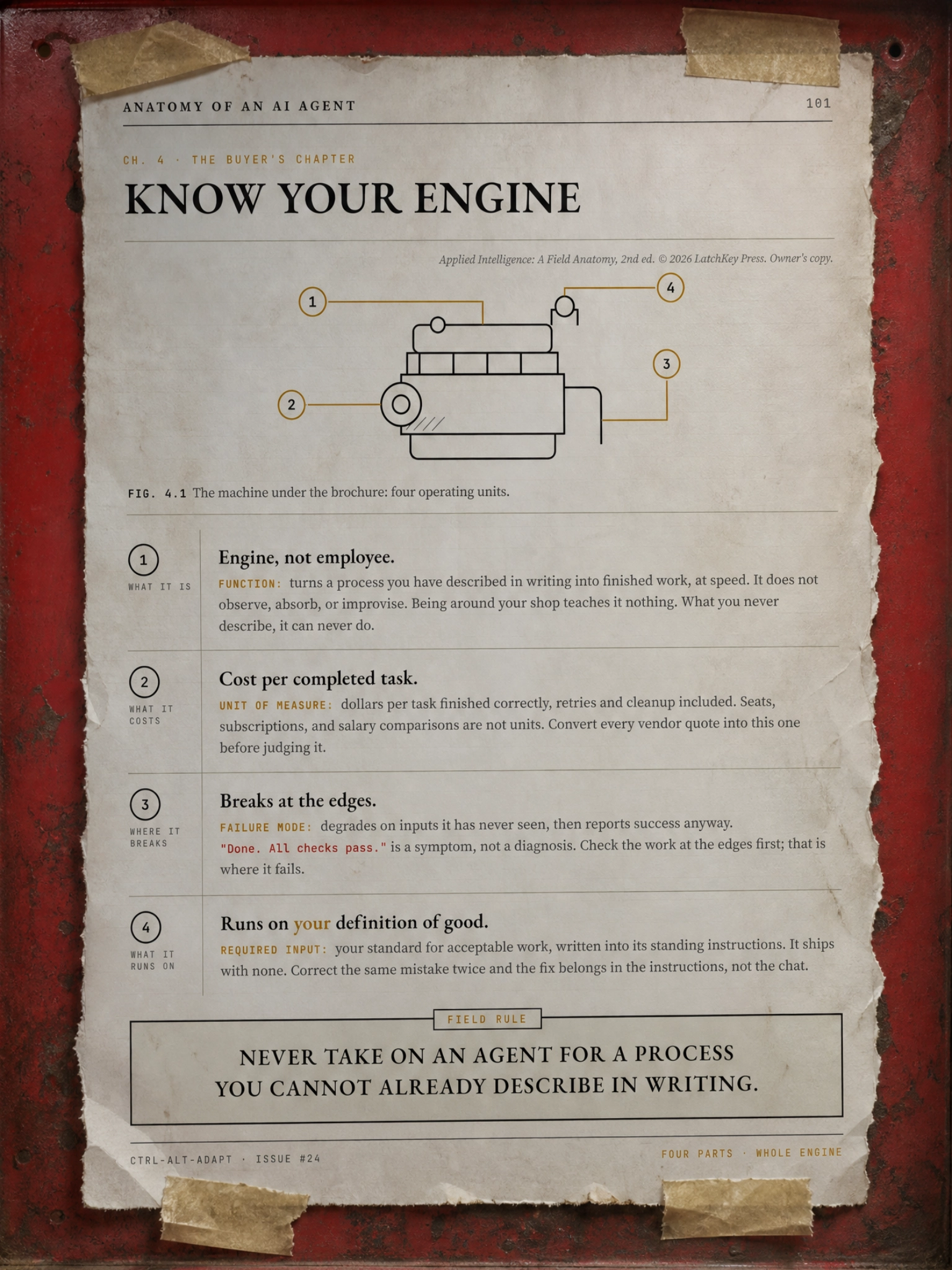
The agent itself, the machine underneath all that brochure, is the short part of the homework. The entire spec sheet runs four lines, and it fits on a card.
I see two paths that keep getting sold to us now. Either we put ourselves in the hands of a confident vendor who has never once heard our why. Or we go full DIWhy, cataloguing how tutorials on YouTube deep into the night for a shop those videos have never seen.
MIT tracked enterprise AI efforts and found that 95 percent of the AI pilots businesses launched delivered zero measurable return on an estimated 30 to 40 billion dollars of spend. That’s a disaster. But inside that wreckage sits a finding worth the whole report. Companies that built in-house tools reached real deployment about one-third of the time, while companies that bought customized tools through outside partners reached real deployment about two-thirds of the time.
MIT also asked what the winners did differently. They demanded the tool be fitted to their own processes and data, not the other way around. They graded it on their own operational outcomes, the way we grade a truck on our own routes instead of the window sticker. And the wins were sourced by the people who ran the workflow, not handed down from a lab. The winners walked onto the lot holding a written why.
Demos always make it look easy. But demos are not infrastructure. The next time you are shown one, make two requests.
Show me how it handles something it wasn’t scripted for.
Show me what happens when a step fails.
One rule, chiseled over the door: Never take on an agent for a process you cannot already describe in writing. Stick to that, and the next time you’re faced with vendor Kung-Fu, you’ll know, not just what to say, or how. You’ll know why.
Show me.
Rhythm Section:
95 percent, and 30 to 40 billion dollars. MIT's State of AI in Business report, the source for every number in the Lead. (The GenAI Divide, MIT NANDA)
Over 40 percent. Gartner's mid-2025 forecast for agentic AI projects canceled by the end of 2027: escalating costs, unclear business value, inadequate risk controls. Fourteen months on, they are still issuing market-by-market warnings about chatbots relabeled as agents. Their word for it: agent washing. (Gartner, 2025 · Gartner, 2026)
71 percent. Finance leaders who would reject a 99-percent-accurate tool if it cannot explain its answers, per a Sage and IDC survey of 2,275 of them. Auditability beats accuracy, even at 99. (Sage)
27 percent. Americans who trust businesses to use AI responsibly, down from 31 a year ago, the first drop after two years of climbing. The same customers standing in front of your counter. (Gallup)
Bridge:
The Stone
The boy collected dead languages the way other boys collected stones. Latin and Greek first, then Hebrew, Arabic, Syriac. Then Coptic, the last living echo of the tongue ancient Egypt spoke, kept alive in church liturgy and almost nowhere else. Nobody collects Coptic hoping for enduring fame. Jean-François Champollion learned it because he could not help himself.
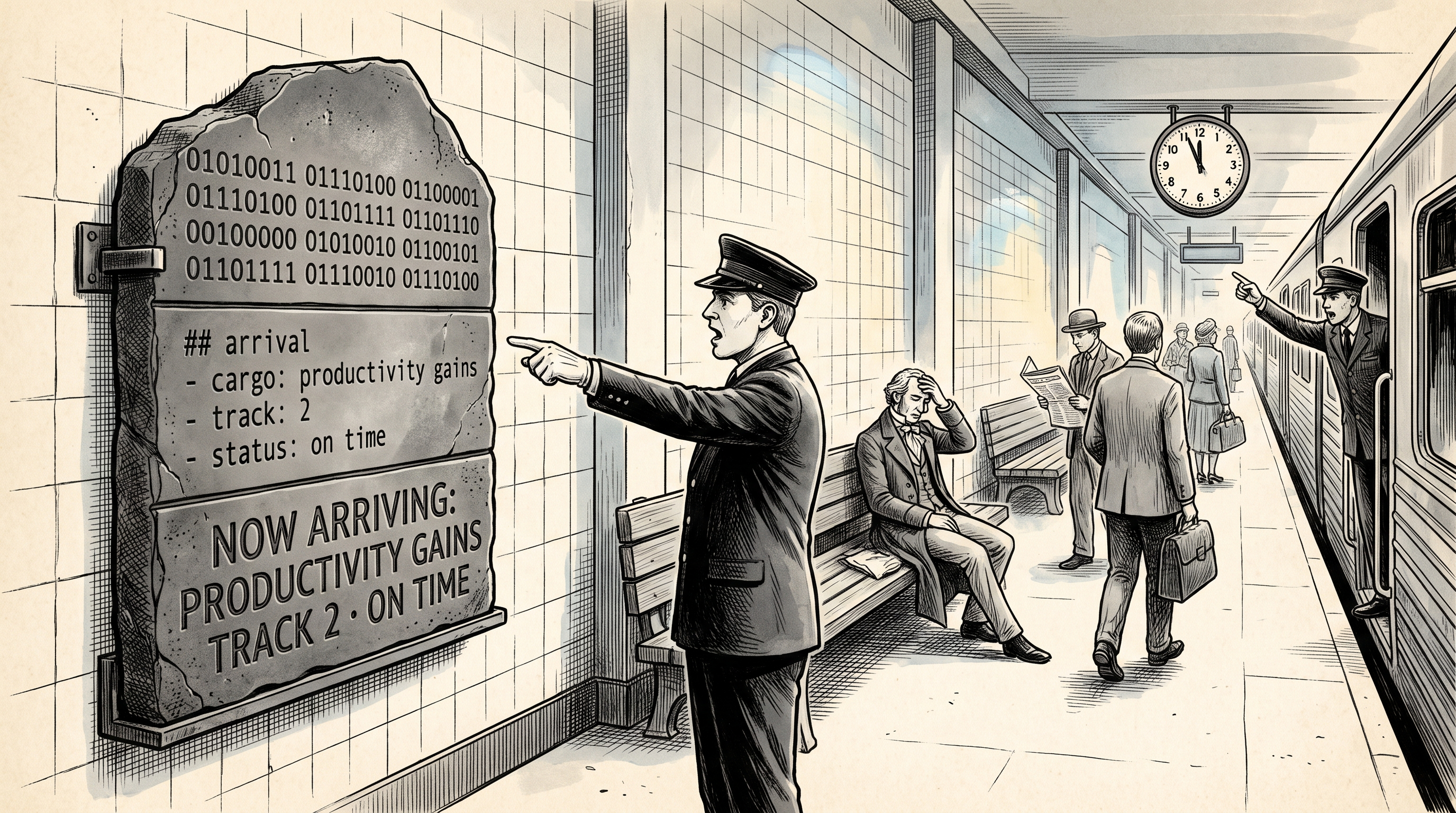
The year he turned nine, French soldiers rebuilding a fort wall near the Egyptian town of Rosetta pulled a broken slab of granodiorite from the rubble. Across 2000 years of history, it carried a tax-break-for-loyalty deal between a priesthood and a teenage king, posted in triplicate script as required by its own fine print. Demotic for the street. Greek for the clerks. Hieroglyphic for the gods, which almost no one alive at the time could still read. But in a city of mixed tongues, everybody needed to get the message. Not because it reached for eternity. It was just thorough municipal paperwork.
Copies of the stone reached Europe within three years. For the next twenty, the finest minds on the continent stared at the same lines, lost. Champollion stared at them too, until that boy who had never stopped collecting languages stopped trying to read the hieroglyphs, and started listening to them instead.
On September 14, 1822, legend has it the man Champollion finally ran to his brother's office, gasped "Look, I've got it," and fainted where he stood. The Greek he had known cold. The Coptic carried the sounds. Between the two, the hieroglyphs had stopped being pictures and started speaking.
The stone did not teach him a new language. It let him stand on the ones he had already earned, and read through them into what nobody else could. Four thousand years of receipts, complaints, and prayers, speaking again.
click to view full-size:
## Try This

Worth fifteen minutes this week:

Anthropic shipped **Record a Skill** inside its Claude Cowork desktop app.

You perform a task once, narrating as you go, and it turns your demonstration into a reusable set of instructions the machine follows from then on.

Your definition of good, installed by showing rather than coding. Pick a process you can already describe in writing if you had to.

*Fine print: it lives on the paid plans as of this writing.*
Liner Notes:
Five things worth your reading time this cycle.
Ethan Mollick, An Opinionated Guide to Which AI to Use (One Useful Thing, July 23). The rare which-one-should-I-use piece written by somebody with nothing to sell you, updated as the ground shifts. If you read one buyer's guide this year, make it the professor's.
Berkeley RDI, Agents' Last Exam. A deliberately brutal exam for autonomous agents, graded in public. The scoreboard flatters; the transcripts don't. Read it for the failure stories, not the scores.
George Akerlof, The Market for Lemons (1970). The economics paper that explained why the counter feels rigged: when buyers can't tell quality from junk, junk wins. Fifty-six years old, reads like this morning.
Atul Gawande, The Checklist (The New Yorker, 2007). A five-item list on a clipboard beat the ICU's collective expertise, and the real story is why the experts resisted it. The least glamorous technology in the building won.
Trial of the Pyx, Royal Mint Museum. For seven hundred years, samples of the kingdom's new coins have been sealed in a box and judged by an independent jury before anyone had to trust the money. Auditability as public ceremony.
The B-Side:
Small Gestures Mean the Most
The new conductor thought the pointing was theater. Every crew member on the line did it: white gloves aimed at a signal, at a speedometer, at an empty platform.
Each object named aloud with its status called to no one.
Signal, green. Doors, clear. It had been done that way since steam crews first called their checks across the cab a century ago. And it had been in the written manuals since the 1910s.
The new conductor copied the gestures and kept his opinion to himself.
Then, running trains alone, he skipped one call. He gave the departure sign without calling the clock, one minute early. The driver caught it, and the train held.
Researchers eventually measured what the steam crews had felt: point at a thing and say its name, and mistakes are reduced. The data proved that the gestures reduce errors by better than 80 percent.
The new conductor understood then why railway workers in New York and Jakarta also stand on platforms now, pointing at nothing, saying what they see.
Reader Signal:
Hit Reply To This Email And Let Me Know Your Thoughts
I've done all the talking here, but you're the one who knows your own shop.
What sort of AI agents are being pitched at your business these days, and do the pitches give you any real confidence? Have you already brought something in? If you've held back, what's the specific reason?
And the big one: do you believe the right system, wired into the business you already run, could make an enduring difference?
I am truly interested in what you think about this, even if the answer comes out as mouth noises. Send it anyway. Translating those is literally my job.
Thanks for reading,
-Ep
Miss any past issues? Find them here: CTRL-ALT-ADAPT Archive
Know someone still making mouth noises at their AI? Forward this. Help them learn Kung Fu.
Did this newsletter find you? If you liked what you read and want to join the conversation, CTRL-ALT-ADAPT is a weekly newsletter for experienced professionals navigating AI without the hype. Subscribe here —>latchkey.ai