| LatchKey.ai | Archive | About | Consulting | Forward |

Issue #22: Time to Carry the One
click to view full-size
Lead Line:
“There is a tremendous potential for destruction.”
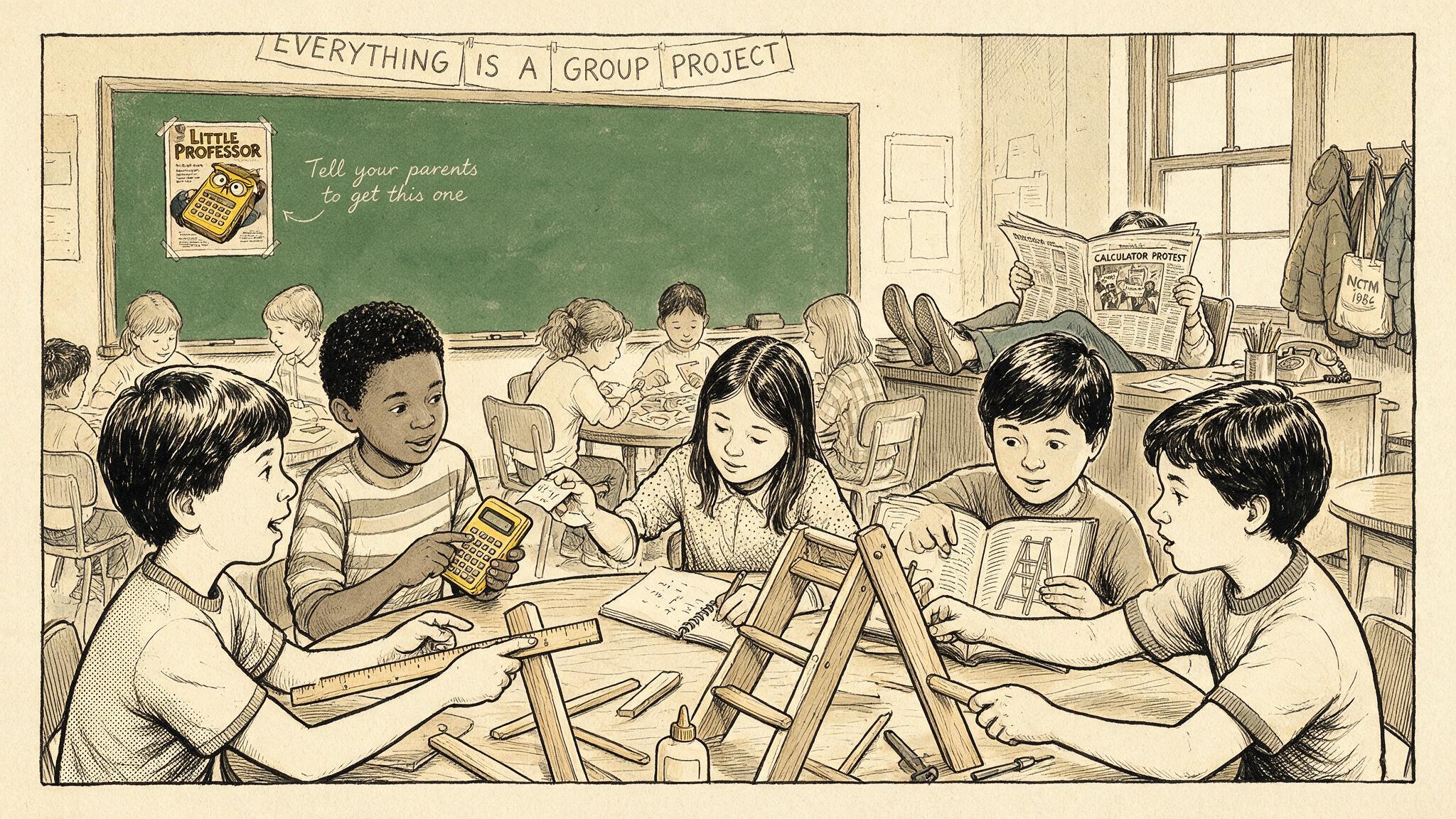
On the morning of April 2, 1986, retired Air Force test pilot John Saxon stood on the sidewalk outside the Sheraton Washington Hotel to deliver that message. Dressed in a sharp navy blazer and a straw boater, he led a group of protesters compelled by a shared fear about the world their kids would now grow up in.
They weren’t there to protest the arms race, or Chernobyl, or anything else we all lost sleep over in 1986.
They were mad about a pocket calculator.
One hand-lettered sign read, “The Button’s Nothin’ ’Til the Brain’s Trained.” Another warned, “Beware: Premature Calculator Usage May Be Harmful to Your Children’s Education.”
Inside, six thousand math teachers shuffled through the annual meeting of the National Council of Teachers of Mathematics, collecting textbook publisher swag, and attending seminars with names like “Heuristic Strategies in Writing Recursive Logo Procedures.”
Saxon wasn’t new to the math scene. He’d published his own no-frills math textbooks as part of his crusade to stop the pocket calculator from spoiling children’s potential. He was moved to act because he understood, all too well it seems, the seductive allure of easy sums the kids were facing. When asked what he would have done with ready access to a pocket calculator as a student, he didn’t blink: “I would have said, ‘Hot dog!’ I would have gone in the corner. I would have gone into the cloakroom. I would have gone behind the building.”
In 1986, John Saxon was worried for the developing brains of us kids.
Because we were the ones in those classrooms, and it’s easy to forget how fast the technology took over. In 1972, an HP-35 cost the equivalent of about $3,000 today, and was a status symbol for engineers. By 1976 roughly one-in-nine Americans owned a calculator.
By the 1980s they were practically giving them away.
That kind of technological whiplash can be deeply unnerving to someone unprepared for the turn. And if what they see coming out of the turn looks like a danger to their children’s cognitive development, well now they’re worried.
Parents in the ’80s got there with chalkboards and multiplication drills, only to watch a rapidly commoditized technology turn their chalk to dust. How would their kids compete in the real world without the hard-won discipline of general arithmetic? Oregon’s 1984 Teacher of the Year, Evie Andrews, kept it even shorter: “Once you have a crutch, you rely on it more and more.”
But was it a crutch?
Or was it just the newest rung on a ladder human minds have been climbing for thousands of years?
While Saxon and his marchers played to the cameras outside, reporters hunting for doom on the convention floor instead found UCLA mathematics professor James Caballero, who casually handed them the longer view. He reminded them that the invention of papyrus five thousand years earlier sparked fears that human memories would “dry up” if people could simply… write everything down. And during the Reformation, there was widespread concern that “books would allow people to read others’ thoughts, and therefore not learn to think for themselves.”
Those ancient concerns seem quaint now, of course, but it’s easy to see why they felt urgent at the time. I mean, how many memories could an ancient Egyptian have really had? And it does get dry in the desert.
But truthfully, with respect to the calculators… the adults weren’t entirely wrong.
And we’re the evidence.
Because the calculator kids grew up, and now they run the world. But they also struggle to split a dinner check, or work out the tip without putting every phone on the table like a quiet séance for the arithmetic they could have owned.
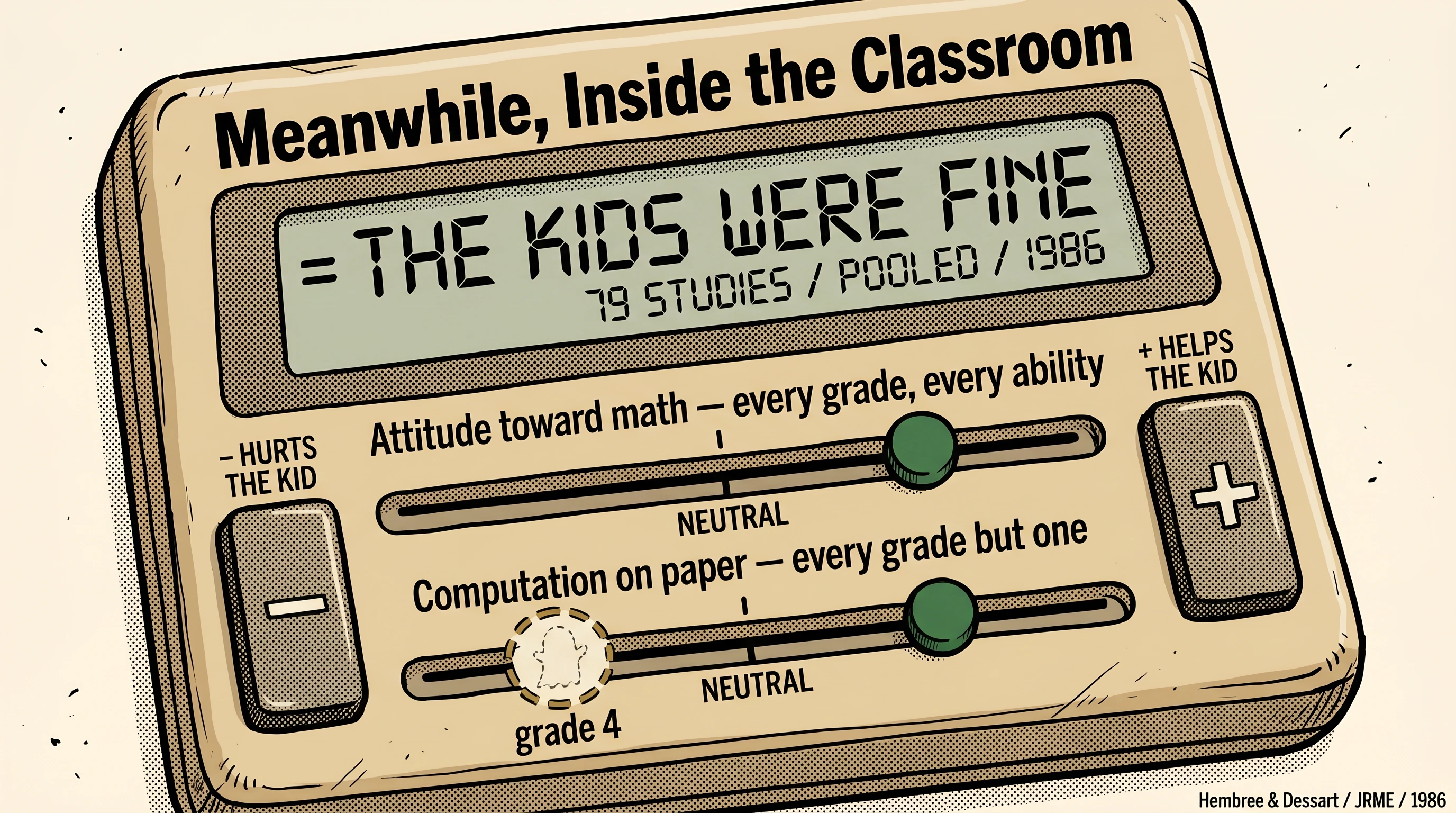
And yet, it doesn’t seem to slow them down. Offloading the simple math to the tool in their hand probably makes them faster.
So the calculator-haters were half right (0.5 percent for those calculating at home). And it’s why this year feels the way it feels to us. The calculator kids are now the AI parents. The worry in our chests is the same one that marched outside the Sheraton, and I won’t try to talk anyone out of it. It’s a responsible worry.
But worry alone never solved any problem.
To solve a problem, you need the facts. You need to examine them. Compare them. Maybe research a piece, or measure another. And you can’t do all of that in your head. Heck, Egyptians could barely hang on to their own memories… apparently.
To do the things that humans do that make us human, we had to invent ways to offload our thinking and knowing. Turns out, that is a prerequisite for progress.
What the Egyptians must have figured out pretty quickly after that initial flinch about memory loss was that writing and drawing take the load off memories, not shrivel them to ash. Instead of drying up, memories got libraries. Books let one lifetime stand and recall across a thousand others. Thinking didn’t wither; science started compounding. The slide rule offloaded the arithmetic, and engineers carried that all the way to the moon.
Every rung on this ladder arrived as a menace, then stayed as a catalyst. As if offloading lighter work onto our tools becomes the scaffolding of our collective intellect. Humans have always used that scaffolding as a ladder to higher thinking. If we gave in to the initial fears, we’d still be lying awake in the desert, nervously clutching our memories for fear of losing them.
Nine years after the great calculator panic of 1986 dimmed, a cognitive scientist named Edwin Hutchins published the paperwork on what the ladder had been trying to tell us all along. Hutchins ran the cognitive science department at UC San Diego, and his work intersected with the years he’d spent watching navy crews bring enormous ships into port. What he noticed was that nobody on that bridge could pilot the ship alone. Not the captain. Not the navigator. Not the quartermaster with the charts. The knowing doesn’t live in any single skull; it lives in the whole system—the crew, the charts, the instruments, the logs—all thinking together. He called it distributed cognition, and once he’d seen it there, he saw it everywhere. The conclusion was obvious.
Thinking was never a solo sport. It only ever looked like one from inside our own heads.
Every generation is born into a pre-loaded world. Nobody has to re-derive fire, or long division, or the cheat codes to Mario Kart. We inherit the answers our ancestors offloaded, and we get to spend our own thinking on the questions one rung up the ladder. That’s the whole trick. From the first notches carved into a whale bone to Wikipedia.
I’m sure you see where I’m going with this, but before I do, I will acknowledge that this new rung is not like the other rungs, and pretending otherwise insults both sides of the table. The worry in our chests is that recognition. But remember, we don’t stop at the worry. That’s social media’s job.
The deeper question is, does different automatically mean wrong? Is there a ceiling on how new new can be?
Every previous rung on this ladder of offloading tools was passive. The tablet, the book, the slide rule, the search bar—they all took what we put in and handed it back when asked.
The tool was a bucket, and the human was the pump.
AI is different because it turned the bucket into a fountain. The pump moved inside, and now it cycles on its own. For the first time, we’re offloading more than the storage of collected knowledge. We’re inviting the tool to handle parts of the processing and synthesis. To make connections on its own. And in some ways, that can look a lot like it’s thinking for us.
And that is the concern that makes us worry about who’s doing the kid’s homework, and also about who’s paying the mortgage.
The first real data that gives us something closer than a fifty-thousand-foot view of AI’s impact crater on jobs is finally in, and the crater is turning out to have a much more nuanced shape than the doom market sold us. In short: the damage isn’t landing evenly on everyone whose job now intersects with AI. It forks by how the workers themselves touch it.
Hutchins would have recognized the signal from the bridge. (The receipts are in the Rhythm Section below, asterisks left in.) The machine has joined the crew, just like the charts, the compass, the radar, the GPS, and the autopilot all did.
And the early data suggests that in some cases that makes the humans on the bridge stronger, more effective crewmates, and in other cases, it makes them spare parts. Distributed cognition doesn’t tell us which branch wins. It just confirms minds were never built to run solo. Ours didn’t. Theirs won’t either.
The question reporters should have asked John Saxon in 1986 wasn’t whether the machines would think for the kids in the future. It was how much higher they would think once the machine is holding the ladder.
And we know the answer now. We are the kids they protested calculators for. We got the forbidden button, and we said, hot dog! And then we used the savings to scurry our thinking further up the ladder than John Saxon’s generation could have ever imagined.
The kids doing their homework with AI in the room tonight have a crewmate on the bridge we may never have imagined, either. And our job was never to keep them off the ladder. It’s to teach them how to climb.
Rhythm Section:
Two 2026 studies back the Lead Line’s jobs line — the Anthropic Economic Index and PwC’s Global AI Jobs Barometer.
From the Anthropic Economic Index, the youth-labor split:
Employment for 22-to-25-year-olds in the most AI-exposed jobs fell 16%. * The canary generation, measured against peers in jobs the machine can’t reach yet.
Workers aged 35 to 40 in those same exposed jobs: up 2%. The dent skips the people who know the work best.
From PwC’s 2026 Global AI Jobs Barometer, the wage and hiring picture:
Wages for AI-skilled workers are up 37% since 2021, against 26% for everyone else. The market is pricing the crewmate premium.
Entry-level postings asking for AI skills: up 35% since 2019. Entry-level postings overall: down 10%. The bottom rung isn’t vanishing so much as being re-carved.
Companies re-tooling the teams they already have are outpacing the ones automating headcount away. ** The power loader beats the pink slip.
(*) Relative employment, not absolute layoffs. (**) Directional, early data — the age dent above and this usage fork are two different analyses; don’t read one as causing the other.
click to view full-size
Bridge:
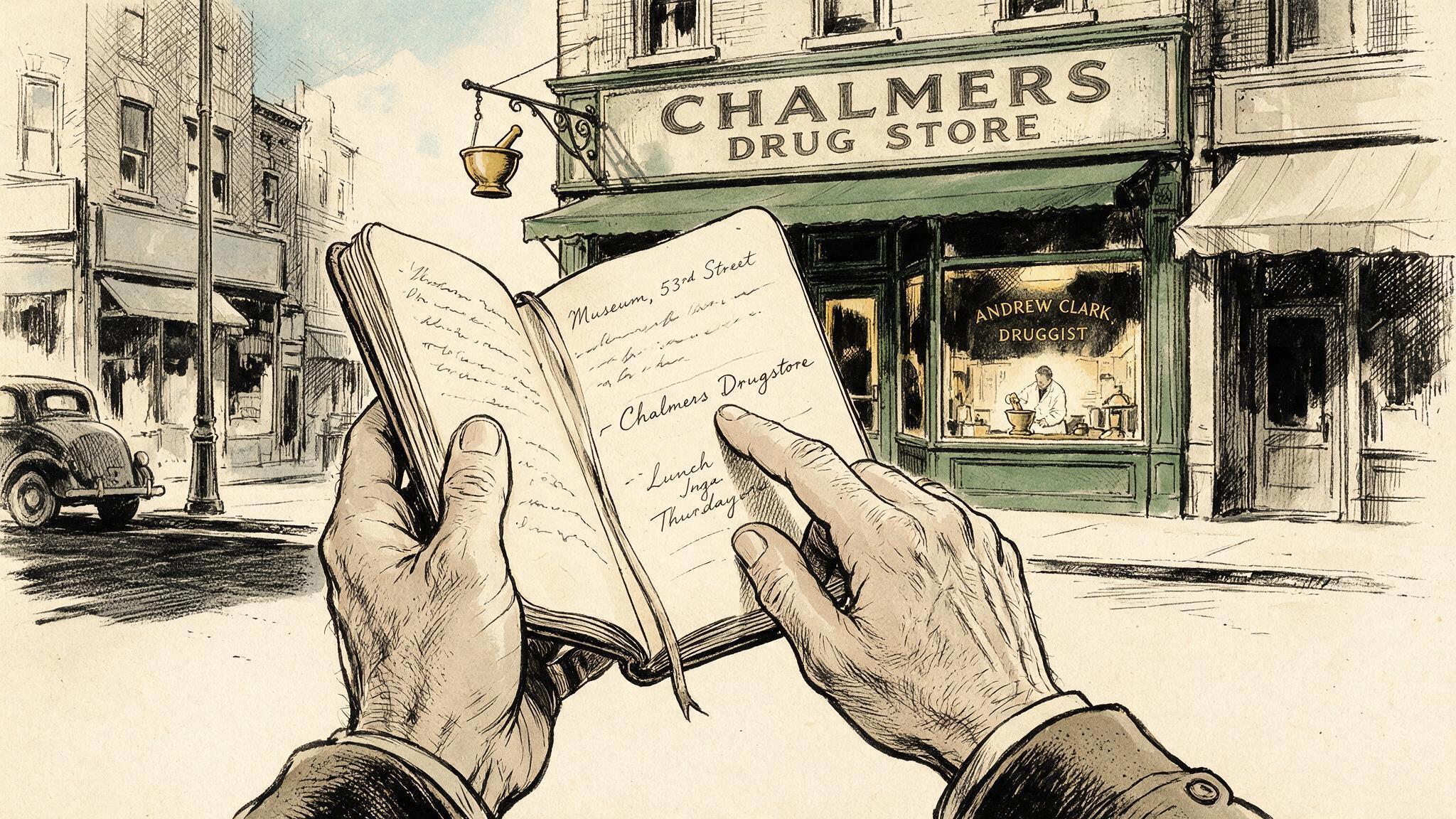
Behind the counter of a 1930s drugstore, the whole job lived in a mortar and pestle, stained gray from decades of powders. Six times out of ten, a prescription arrived not as a finished pill but as raw ingredients: crystal weighed on a brass balance, ground fine, packed into capsules, or stirred into a syrup that still carried a whiff of the alcohol underneath. Nobody handed you a manual for that. You learned the trade by grinding it, one prescription at a time, until the bench itself had taught you everything it knew.
Then the tablet factories opened, and identical pills rolled off a belt by the million. The ending seemed obvious to everyone watching: the marble slab goes quiet, and the person behind it spends a career counting tablets into little paper cups. A shopkeeper in a white coat. Nothing more.
That’s not what happened.
The counter did close. But the profession didn’t shrink down to fit what was left of it. It took every hard lesson the bench had taught and built a doctorate out of it. By 1997, four years of pharmacy school wasn’t a distinction for the ambitious. It was the price of the coat.
Today’s pharmacist may never grind a powder, but they carry more pharmacology in their head than any compounder ever touched with their hands, standing watch at the last counter between a patient and ten thousand ways a drug interaction can go wrong.
The rung didn’t disappear. It moved up.
Interlude:
click to view full-size
Coda:
click to view full-size
Liner Notes:
“The Great Calculator Debate,” Christian Science Monitor, May 1986. The full picket-line dispatch, Saxon’s own words intact. Bring popcorn for the Oregon teacher who compared math homework to golf carts.
Edwin Hutchins, Cognition in the Wild (MIT Press, 1995). Chapter three lands you on the actual bridge, watching the actual crew, watching each other. Longer than a Sunday afternoon deserves, worth every page anyway.
Plato, Phaedrus. Socrates gets going on writing somewhere past the halfway mark. He’s not wrong that something changes. He’s just extremely sure it’s not for the better.
Andy Clark and David Chalmers, “The Extended Mind” (Analysis, 1998). Meet Otto and his notebook properly, philosophers arguing in full seriousness about where a mind actually stops.
Atul Gawande, The Checklist Manifesto. Surgeons, of all people, needed a dumb piece of paper to stop killing patients by accident. Make of that what you will.
The B-Side: Otto’s Notebook
Otto has a terrible memory. He carries a notebook everywhere: his address, his wife’s name, the walk to the museum on Fifty-Third Street. When he wants to see the new exhibit, he doesn’t rack his brain. He flips to the page, reads the address, and walks there without a second thought.
Inga has an ordinary memory. She wants to see the same exhibit. She thinks for a second, the address surfaces from somewhere behind her eyes, and she walks there without a second thought.
Two philosophers noticed something in 1998 that still keeps their students arguing at 2 a.m.: nothing else in that story changes if you swap the notebook for the neurons. The address sits outside Otto’s skull instead of inside it. He trusts it the same way, without checking twice. He acts on it the same way, the moment it surfaces.
So where does Otto’s mind actually end? At his skin? Or at the edge of the notebook?
Nobody at the museum ever asks him that. They just ask what he thought of the exhibit.
Thanks for reading,
-Ep
Miss any past issues? Find them here: CTRL-ALT-ADAPT Archive
Know someone who still thinks they’re a solo thinker? Forward this. Distribute them some cognition.
Did this newsletter find you? If you liked what you read and want to join the conversation, CTRL-ALT-ADAPT is a weekly newsletter for experienced professionals navigating AI without the hype. Subscribe here —>latchkey.ai