| LatchKey.ai | Archive | About | Consulting | Forward |

Issue #21: Local Models Eat Business Models
click to view full-size

Lead Line:
The rigged room you already know.
There was a stretch in the early 1980s when a new technology obsession exploded into popularity with near-religious fervor. Soon big, loud cathedrals of observance were popping up all over. My friends and I would eagerly show our devotion on the weekend… if we could get a ride to this new church. We would spend the rest of the week doing odd jobs and being as helpful around the house as we could be, in the hopes of earning some extra dollars to bring.
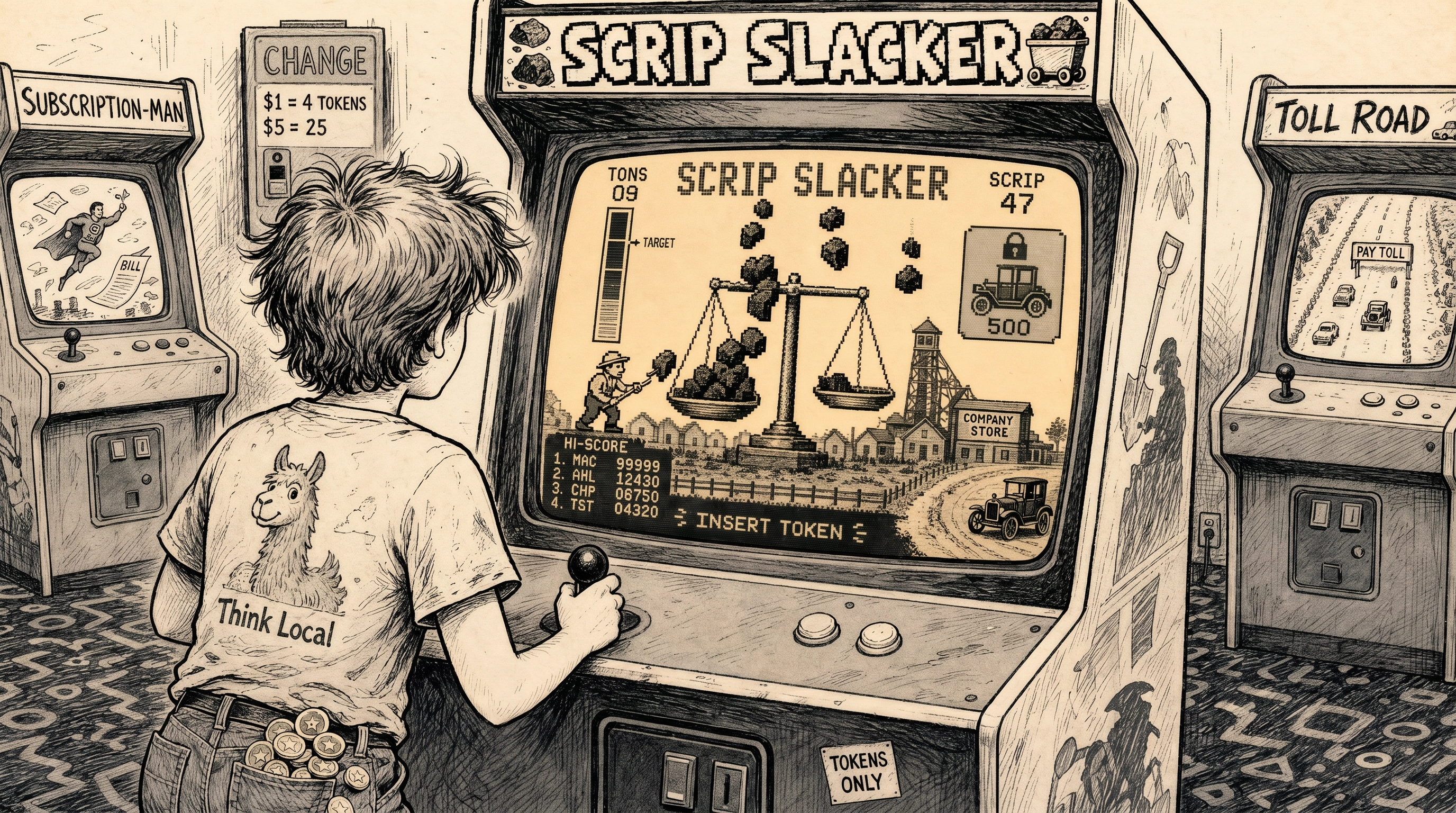
The first stop upon entering the glimmering halls was the change machine. It ate your dollar and gave you back a fistful of brass tokens. That was the deal at the arcade, and we never once questioned it. Four quarters in, four tokens out. And if you could pony up a fiver, it would give you twenty-five, which felt like getting away with something.
Brass in hand, you walked the gaudy carpet under the black lights like a high roller, marveling at the magnificent sights and sounds. Your heart pumping in anticipation of a new high score.
Then your mom showed up early, or the line for the good game was twenty kids deep, and you went home with zero cash, and a pocket full of tokens you couldn’t spend anywhere. Not at the 7-Eleven, not at the record store, nowhere but the one room that minted them. You were locked in.
We never called that a rigged trade. We called it the cost of fun on a Friday night or a Saturday afternoon. Sure, the stakes were low. Missing a week might mean being left out of lunchtime conversations around the latest secret moves in the newest games.
Zoom out and turn back the clock though, and the stakes go up by about sixteen tons. Around the turn of the twentieth century there was a similar playbook run in places called ‘company towns’. Same lock-in, none of the joy. The mill that employed the residents paid wages in scrip instead of dollars. The scrip could be spent at the company store, where the company set the prices, and for the rent on your company house, all before you ever saw any real cash. You could work a full week for the company and end up owing them money.
Another day older and deeper in debt...
The genius of the arrangement for the company was never the work you did for them. It was that there was nowhere else to spend what you earned. A closed loop that favored only them. No Mom coming to drive you home.
We have been living through Act 1 of the AI era, and they’ve been handing us tokens again while telling us every day how much we will come to rely on what we must pay them to access. You load dollars onto an account, converting them to a private currency. And that currency spends at exactly one store. Run the meter up, watch the balance fall, buy more. Rinse and repeat.
We have been told this is simply how the electricity comes now, metered from a faraway plant we will never see and could never build ourselves, but that our future success depends on. The dread so many people feel about all of this, the thing driving the headlines, was never really the technology itself. It is the enclosure. The lock-in. It is the quiet assumption that the most important tool of the next thirty years can only be rented, from a handful of people, on their terms.
But that is the company line, and there is another way forward. What we see today, this summer, is a pitched race. A sprint between the propaganda-driven frenzy for centralized investment and the organic development of a technology that wants to be free.
If you’ve not heard the terms ‘Local Models’ or ‘Open Weights’ yet, or you had, but didn’t know what they meant, welcome to Act 2 of the AI era. The future is local. Because local doesn’t fight the company store. It makes the store irrelevant.
The store is overstretched.
Let’s first pull back the curtain on the store itself, because it is not as sturdy as the marketing suggests. The current 800-pound gorilla in this game, OpenAI, lost nearly twenty-one billion dollars from operations last year on about thirteen billion in revenue, while spending something close to thirty-four billion to do it. They, along with the eager amplification of the venture capital propping them up, have persuaded the markets to set their value at more than forty times revenue by promising the moon and the stars.
Nothing puts more wind in a tech company’s sails today than getting priced near a trillion dollars ahead of their IPO. Whether any of it maths on paper seems beside the point.
Those are not the numbers of a utility, unless you can heat your town by burning money. And the theater of urgency these companies manufacture, the sense that you must get aboard this instant or be left behind forever, is the 'call in the next five minutes and we'll throw in the steak knives' infomercial energy we grew up with, in a Merino wool turtleneck now.
The data centers, the water, the strain on the grid, the hoarded RAM and GPUs that have made it too expensive for the rest of us to build anything at all, every bit of it is sold as the only possible road to the future.
It is not the only road. It’s just the toll road they happen to own. And it's the one that leads to their true goal. Not worker liberation. Not AGI. Shareholder profit. But guess what? They know it is not the only road, because they all helped build the alternatives.
In 1975, Kodak, the venerable stalwart synonymous with film photography, invented its own technological successor. They created the digital camera. They patented it, and then starved it for forty years, because the future it promised was less profitable than the film they were already selling. They owned the markets and distribution. The status quo kept their shareholders happy. So when Steven Sasson, the young engineer who actually built the thing, carried it in to his bosses, the response was not awe. As Sasson would later recall to The New York Times, management's verdict was, “That's cute — but don't tell anyone about it.”
The tighter a company squeezes the market it already owns, the more its imagination goes numb.
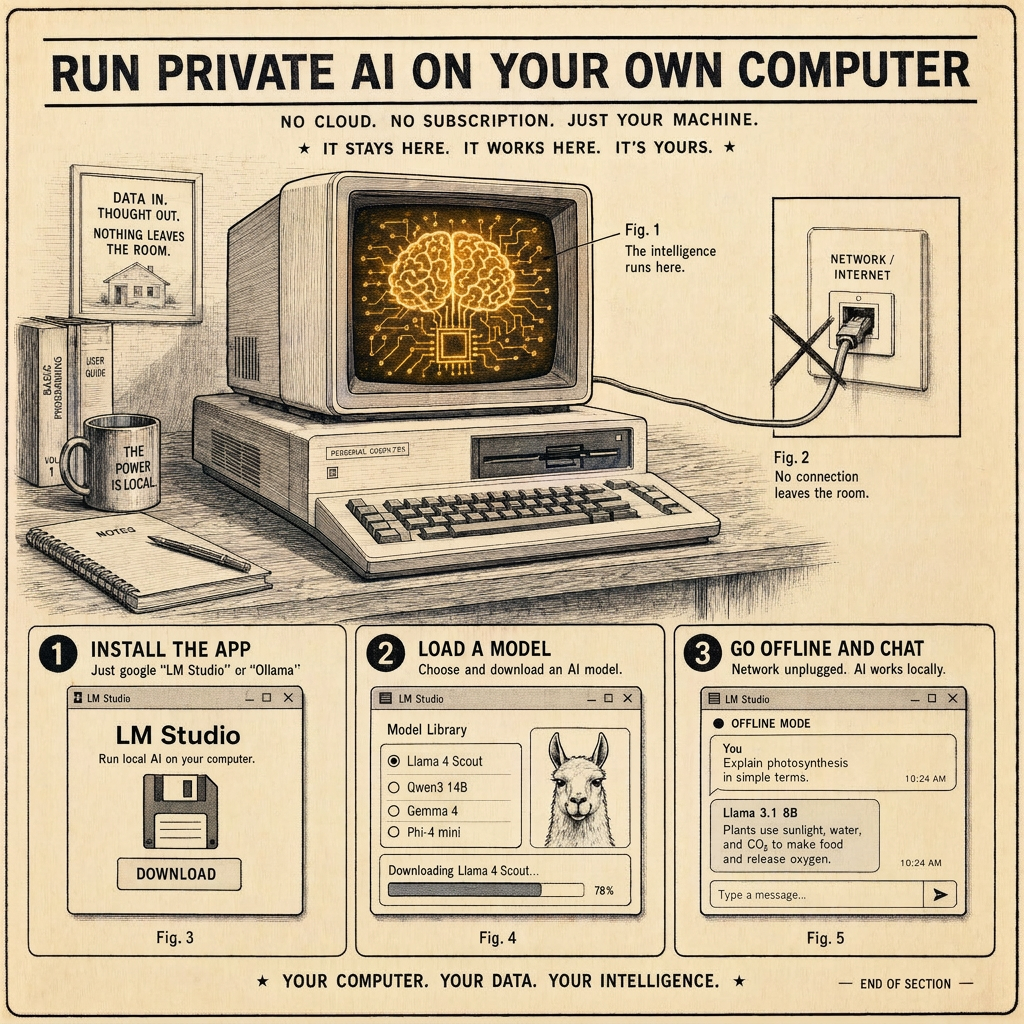
Every frontier AI lab today has small, efficient models sitting in their own drawers right now. AI back roads small enough to run on your own devices without the cloud. Private, secure, free. (What one actually is, and how you'd run it yourself, is in the manual a little later in this issue)
Keeping us on the toll road is a strategy, not a necessity. And while the giants tend to their furnaces, the appliances have quietly begun to come home.
There's this other tech company you may remember. Apple. Where the heck have they been this whole time? For three years, we observed what is arguably the most successful tech company in history seemingly sleep through the most significant technology shift in forty years, and we wondered how on earth they had missed the boat.
They didn't miss the boat. They were building the dock.
Back in 2017, Apple quietly added a dedicated neural engine to the iPhone architecture. Silicon built for the sole purpose of running machine learning directly on the device. They called the chip the A11 Bionic, and it’s what enabled us to unlock our phones with our faces… and make Animoji? Their competitors and the tech world called the Neural Engine a party trick for cartoon poop emojis.
It was not a party trick. It was a beachhead.
In 2020, Apple made the move almost everyone misread as just a laptop story, or an effort to better control their component prices. They ditched Intel and put their own proprietary silicon in the Mac. A massive transition for such a manufacturing behemoth. The pundits called it a battery-life efficiency tweak. But buried beneath those headlines, the real story was unified memory.
Traditional chips split memory into separate pools: one small, walled-off pool for the graphics chip, another large one for everything else. Data shuttles back and forth across a narrow bridge. That was fine for the old computing rules, but AI models are simply too big for that bottleneck. Unified memory eliminates it.
The Apple M-series uses one pool of fast memory the entire chip can reach at once, with nothing shuttled back and forth between compartments. At the time, it read as a nice, but bespoke, efficiency tweak. In hindsight, it was the whole ballgame, because unified memory is exactly what lets a large AI model live on a machine you own instead of in a data center you rent time from.
Apple wasn’t caught flat-footed by the explosion of AI. They had been quietly laying track toward this exact moment for years, in plain sight, while the world mistook patience for absence. Remember, ChatGPT didn't arrive until the end of 2022. Apple built the dock before most of us knew we even needed a boat. Because Apple never forgot that they are a hardware company first.
Last week, Apple announced their own twenty-billion-parameter AI model that runs on an iPhone. Entirely on the device. No internet required, no meter running. The unified memory architecture they shipped years ago is exactly what makes the trick possible.
They’re not pretending to have won the whole war. Siri now leans on Google's Gemini for some of her heavier thinking, which is still someone else's cloud and someone else's chips. Apple has been oddly candid about winning the layer they own while renting the layer they don't. But that candor is the tell. They know where the battles of the near future will actually be fought, and they have been digging their moat for years.
Apple is the most notable bellwether, but you can hear the others coming if you listen. The quietly building hoofbeats of a legion of small models gathering just beyond the horizon, growing louder as they close, arriving not by the toll road we all stand on today, but from every direction and over every kind of terrain.
Drive past the store.
We already know how this story ends, because we lived the first version of it. The video games held captive behind the terms set by the arcade owners came home as consoles. We stopped feeding tokens into a machine we would never own, in a room full of other people waiting their turn, and we bought the game and played it in our own living room as many times as we liked. Nobody had to picket the arcade, or legislate our access. The big rooms just went quiet on their own, one by one, because the reason to stay locked into their token-based business model had evaporated.
That is the move in front of us now, and it’s much older than the arcade example. What finally broke the company towns was not a strike. It was the arrival of the automobile. An ownable asset a worker could use to break free of the lock-in. Once they could drive to a store outside of town for a better deal, the company store could no longer charge whatever it wanted. User captivity was the entire business model there too, and then the chains were broken.
The era of the company town didn’t end with a fight. It ended with the sound of tires on gravel fading into the distance.
Local models break the chains of forced AI lock-in the same way. They're the difference between renting agents from someone else and getting your own agency back. The plain capacity to do the work yourself, on your own machine, without asking permission, and without feeding a meter.
More than just the cost savings, running this stuff at home mitigates a ton of the privacy fears and dystopian dread the current centralized business models create. The kind that makes us all feel like hostages to a small klatch of billionaires wielding their egos in a self-serving competition for godly bragging rights.
Boys and their toys…
Instead, local models mean we can keep the intelligence where we keep everything else we trust. In our house. On our desk. On the thing we already paid for. Where the data never leaves and the meter never runs and nobody gets to ration how much of the future we’re allowed access to each month.
But listen, I’m certainly not here to match the hyperbole of the hyperscalers with my own. Local models aren't going to be an extinction-level event for the big dogs. The frontier labs won't vanish, and they will have their place. The open-source model you run on your laptop will likely still be trained by one of them. Local AI does not make us free of their existence. It makes us free of their insistence.
And the truth is, keeping our computing on our desk and out of the cloud does not dissolve every hard question about safety or misuse or the people whose livelihoods AI disrupts. But what it does dissolve is the dependency. The store will still be standing. You’ll just be free to drive past it.
Rhythm Section:
The receipts, for anyone still pricing the toll road as the only road.
Anthropic is projecting around $559 million in operating profit for Q2 2026, while the market leader bled close to $21 billion from operations in a year.
Same race. Opposite direction. The bleeding was a choice, not a law of physics.
Companies aren't waiting for permission to bring the work back in-house.
That is a number priced for a future the revenue hasn't agreed to yet.
The distance between "rent it" and "own it" is down to about one season.
The spec that decides your AI future isn't a data center anymore. It is the memory already in your laptop.
click to view full-size
Bridge:
For most of the 1800s, the most precious metal on earth was not gold. It was aluminum.
Sounds crazy, right? Aluminum is the third most common element in the entire crust of the planet, behind only oxygen and silicon. Yet it cost a fortune.
The price had nothing to do with how much of the stuff existed. There’s more aluminum in a single shovel of dirt than there is gold in a thousand dump trucks of it.
But back then nobody had a cheap way to pull it from the rock and clay it loves to mingle with. It was everywhere and out of reach at the same time, so it got priced as ‘rare’ even though it wasn’t.
By the 1850s, aluminum was worth almost twice what gold was per ounce.
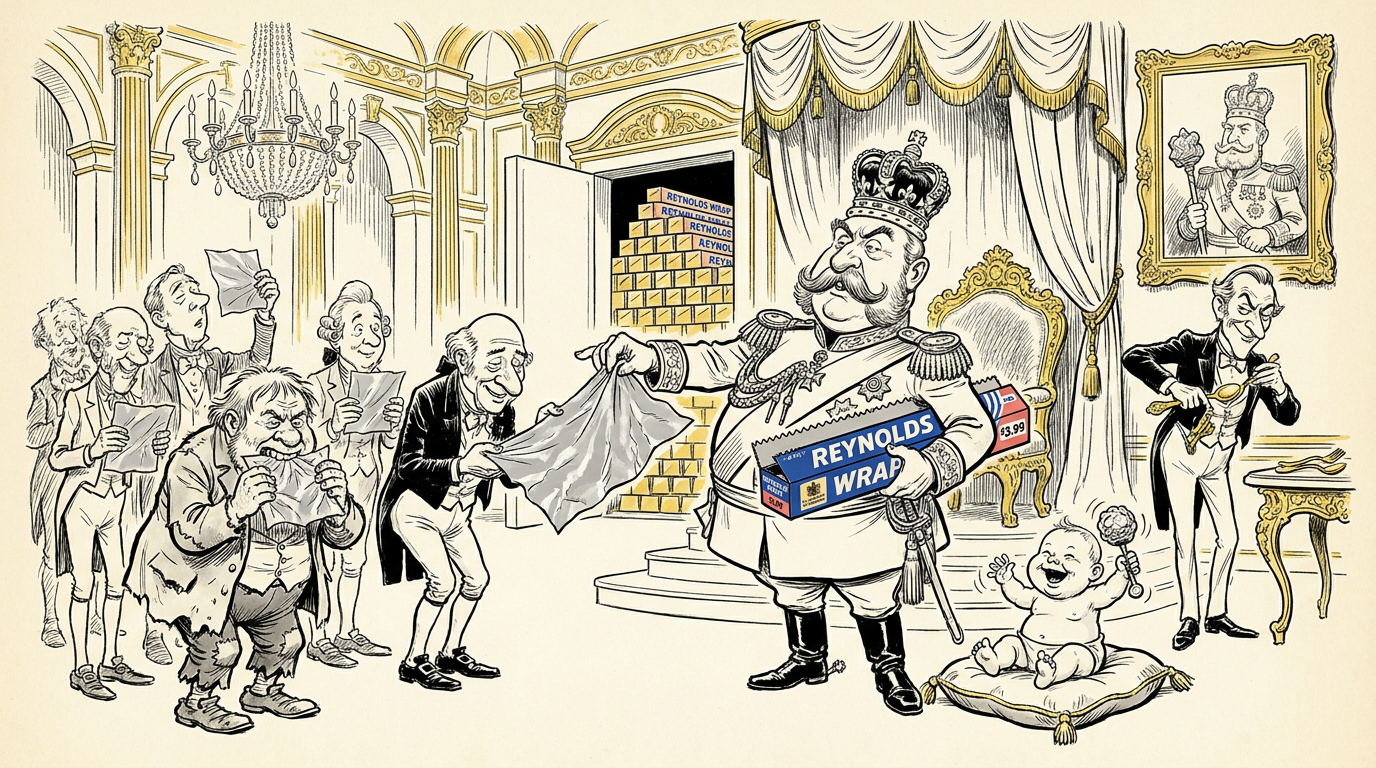
Napoleon III served honored guests with aluminum forks and let the rest slum it with gold utensils. His infant son had an aluminum rattle specially forged. For a few decades, the most ordinary element on the planet was a wealth flex for emperors.
Then in 1886, a couple of nobodies in their twenties who had never met, one an American and one a Frenchman, cracked the code in the same year. Run a high current through aluminum ore dissolved in a molten mineral bath, and the pure metal sinks to the bottom of the pot. Simple.
The price quickly dropped like the stone it was extracted from. From dollars a pound to cents. In short order, the metal of emperors became the thing you wrap your leftovers in and toss in the back of the fridge.
Nothing about the metal itself had changed. Only the cost of accessing it.
Interlude:
click to view full-size
Coda:
# Find your number.

On the machine you use most, look up how much memory it has. (On a Mac: the Apple menu, then About This Mac, the figure next to Memory.) Write it down.

That one number is the whole gating spec for running a model at home.

Roughly:
8GB:  - runs small but useful models
16GB: - runs models that will surprise you
32GB+ - runs last year's frontier-class models

You don't have to install a thing this week. Just learn your number. The future they keep telling you to rent already fits on hardware you bought years ago.
Liner Notes:
Curated outside listening. Two to go deep on, four to follow the signal.
Albert Hirschman, Exit, Voice, and Loyalty (1970).: When a thing you rely on starts to slip, you get two moves. Voice, which is staying to argue it better, or exit, which is just leaving.
Marc Levinson, The Box (2006).: A North Carolina trucker named Malcom McLean looked at the entire entrenched world of dockworkers and hand-loaded cargo and did not fight it. He put everything in a standardized steel box and made the old way obsolete, dropping shipping costs to roughly three percent of what they were.
The OpenAI numbers, read straight (Ed Zitron, corroborated by the Financial Times).: The most useful financial read of the year, precisely because it refuses to sharpen the scary number. The real burn is smaller than the headline, and somehow more damning.
Prohibition's grape bricks.: Selling wine was the crime. Making up to two hundred gallons a year at home was fine. So California growers pressed their grapes into dried bricks and sold them as “juice”, wrapped in a thinly veiled ‘what not to do’ warning that amounted to step-by-step instructions for making wine.
How the Sears catalog opposed Jim Crow (Louis Hyman).: In the Jim Crow South the white-owned store held your credit and your crop. Then a catalog showed up, and a Black family could order the same overalls, tools, and guns as anyone, by mail.
One good open-weight model runner: LM Studio.: Not a manifesto, just a download. Go ahead and kick the tires. It’s free.
The B-Side:
Flip the record. One idea that didn't fit the A-side.
Out past the grain elevators around dusk, you'll sometimes catch it. A few thousand starlings coming home to roost, except they don't fly home so much as pour there, folding and snapping and turning inside out like a bedsheet caught in the wind. People pull their cars over for this. They've even given it a name. A murmuration.
Here's the part that gets me. There's no lead bird. Nobody up front calling the shape. Each starling just tracks the six or seven nearest it and matches them, and somehow that adds up to one thing the size of a parking lot, moving like it's got a single mind and somewhere to be.
A falcon will dive straight through it and come up with nothing. Not because the flock is fast. Because there's no center to aim at. You can't behead a thing that was never wearing a head.
We keep waiting for someone to lead the way out. Maybe it was never going to be led. Maybe it just gets joined. One bird, then the seven beside it, then the whole sky.
Thanks for reading,
-Ep
Miss any past issues? Find them here: CTRL-ALT-ADAPT Archive
Know someone still saying the rent is too damn high? Forward this. Help them break free from the lock-in.
Did this newsletter find you? If you liked what you read and want to join the conversation, CTRL-ALT-ADAPT is a weekly newsletter for experienced professionals navigating AI without the hype. Subscribe here —>latchkey.ai