| LatchKey.ai | Archive | About | Consulting | Forward |
Issue #20: Instrument Rated

click to view full-size
Lead Line:
There's a thing I do when a feeling shows up that I don't appreciate.
I stop. I step back from it like I'm watching myself on a monitor. And I ask one question.
What did I expect?
Not what's wrong. Not what do I want, or what am I scared of. What did I expect, walking in.
I worked this out many years ago, and it has been a rudder for me across my life. The feeling was never about the thing. It was about the distance between what I expected and what actually happened. Close that gap and the feeling changes, even when nothing about the thing moves an inch.
Picture two runners at the same marathon. The first one spent the last couple of years on the couch eating pizza. About 30 days ago he decided, deep in his heart, that he's gonna win this race. He has to. But instead, he finishes exactly where a guy full of pizza who got off the couch a month ago should finish. He's crushed. Ashamed, even. Broken.
The second runner trained some, but still lined up eyes open, knowing he had no business believing he had a snowball's chance in hell to even finish. In the end, he drags himself across the finish line dead last, gasping like a reed instrument. And feeling like a champion.
Same race. Same finish line. Two completely different reactions. The only thing that moved was the expectation each of them carried to the start.
Pay attention to your expectations. That's the maxim.
I learned to consult mine. Quietly, off to the side, like checking a gauge. When I recognize I'm anxious or angry, or just wound a little too tight about something, nine times out of ten the gauge reveals an expectation I never agreed to out loud, doing damage I never signed up for.
Catch it. Name it. Recalibrate it to something that objectively makes sense, and usually the feeling settles.
Mastery is recognizing and calibrating the expectation before the undesirable feeling even has a chance to emerge. That's a life-long pursuit.
It might be the oldest tool I own. So when this strange new technology arrived, I tried to temper my assumptions. As people began broadcasting their feelings about it, loudly and with certainty, I checked the gauge.
That gap, the one between the feelings everybody was announcing and the expectations nobody was checking, is why I started this newsletter.
I don't have to tell you that people's feelings about AI have only gotten much stronger in the months since. So let's do the thing nobody's doing. Let's look behind the feelings and see if we can find the expectations that spawned them.
Since ChatGPT showed up in 2023, we've all run some version of this thought more than once: interesting tech, but I'm not handing this thing my financial info, my health records, my real decisions. Not until it's bulletproof. I can't afford to be wrong.
Absolutely. Me, too. That is a deeply reasonable level of caution. Sounds like wisdom, even.
But against what bar? Bulletproof. Cannot be wrong. Hang on…where did we get the idea that a tool had to be infallible before we'd trust it with anything that mattered?
The same place we get everything else. Experience. Forty years of computers and software. We grew up on machines that did precisely what they were told, the same way, every single time. That was the point of them. A calculator that's right ninety-nine percent of the time isn't impressive. It's broken. We'd throw it out. Spreadsheets are calculators. When we typed into Lotus 1-2-3, glowing green in a dark office, we didn't expect it to have an opinion or a mood. We expected it to calculate perfectly, every time.
Perfection became the toll of our machines. The price of admission for anything with a keyboard and a screen. And it worked, because for forty years everything with a keyboard and a screen really was just a calculator underneath.
Then this new thing shows up on our screen. What did we expect when we typed into it? <Enter>
The screen answers. And without thinking about it for one second, we filed it in the same box. Calculator. That was the moment it inherited the calculator's bar. Bulletproof, or no thanks.
Now picture Jerry, from accounting. Sharp as anybody, been there longer than the carpet. Cool as a cucumber. At the lunch table, somebody throws out a numbers question, fifteen percent of this spread across that, blah blah.
All eyes go to Jerry. He squints, pokes at his sandwich, and rattles off a confident answer.
Do we reach for a calculator to check Jerry, or do we keep eating? Right. We take the number, we nod, and if it really matters, we might run it later. But hang on a sec. That might be the lowest-stakes thing we ever ask of Jerry. We trust him with the consequential stuff, and we never once expected every answer out of him to be bulletproof.
Because the bar for Jerry doesn't demand perfection. It demands judgment. Verification. A second set of eyes. And the chance to correct course when he fires a dud.
But the new thing, whose whole shtick is simulating a human-like exchange, we set at the calculator's bar.
What if we filed it wrong? What if it's not a calculator?
What if the AI apprehension was never a trust issue, but a sorting error?
Now we can see the expectation.
If we recalibrate it. Re-file it. The bulletproof demand starts to change shape. And maybe our feelings along with it.
Don't misread me. It doesn't discredit a rational level of caution. There's no shame in feeling apprehensive about handing critical or sensitive information to a new technology. Or worse, blindly trusting its conclusions about that information. What are we, new? There's a hard little scar inside that reflex, installed by a Nigerian prince, via email, lo those many years ago.
Fool me once…
Some actions can't be taken back. Money that leaves doesn't come home because we said oops. And some data, once handed over, can't be un-handed. Those aren't reflexes. Those are facts, and we can't change them.
But we can change our expectations around the technology.
A different expectation invites a different kind of planning. Different kinds of engagement. Keep a human hand on anything that can't be undone. Keep the sensitive stuff close. And be patient, because there's a version of all this coming, sooner than most think, where it all runs on our own machines and the data never leaves the house. More on that, another week.
Ok, so if it's not a calculator, what is it?
It's an instrument. An elaborate gauge. A device for examining ideas. We bring it something: a question, a hunch, a half-formed itch we can't quite word yet, and we set it on the bench and turn it. We catch the angles and edges we'd never have found on our own. And we recognize that what we get back are data, not answers. It's often gobsmackingly rich data, but the answers, the conclusions about the data, are still ours to make.
And from inside that frame, "Is it bulletproof?" stops making sense at all. Ask a scientist. Nobody who works with instruments blindly trusts a single reading off a single uncalibrated device. But they still want the data. They cross-check. They benchmark. They learn the quirks of the gauge well enough to tell a real signal from an artifact of the machine. The data has no opinion of its own. It gets interpreted.
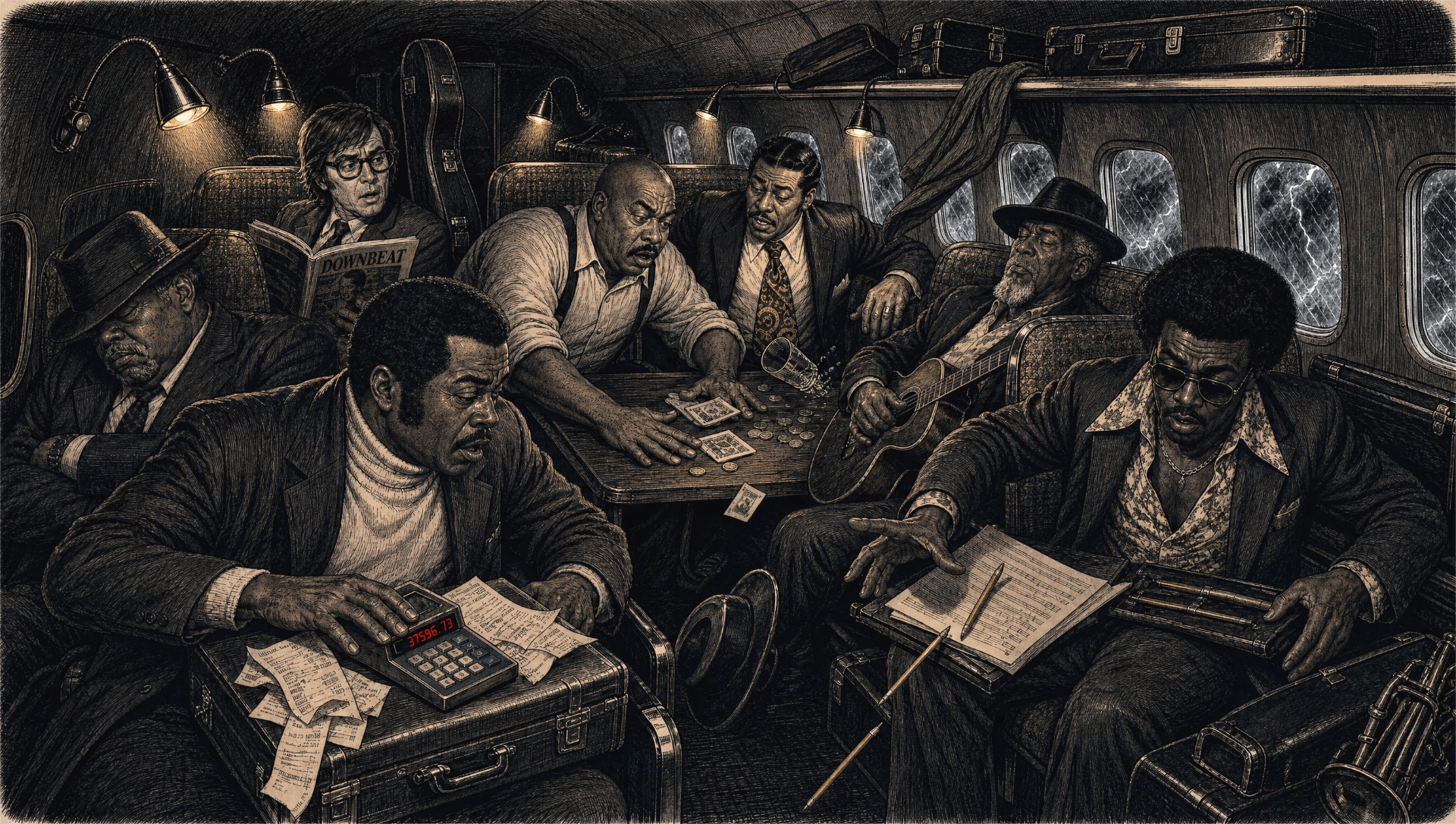
Think about what it means to be instrument rated. A pilot sits with the windshield packed solid with cloud, nothing out there but white, and flies the airplane anyway. Not by staring harder into the nothing. By reading the gauges. Altitude, attitude, heading, the artificial horizon. Not one of those instruments flies the plane, and not one of them decides a thing. They feed readings to the one who does. The rating was never a certificate that the pilot understands the instruments. It certifies that the pilot can be trusted to weigh them all and command the aircraft when their own eyes have nothing left to offer. The instruments inform. The human decides.
The calculator only ever gave perfect answers to questions small enough to be calculated in the first place. Perfection was always the consolation prize for the trivial.
If you insist on the calculator's certainty, you stay confined to the calculator's questions.
So, we filed it wrong. Ok, but the good news is: it's still plenty early, and we can recalibrate. But more importantly, that filing error was never really our fault.
We didn't pick the calculator box out of thin air. It was handed to us, pre-labeled. And that label is the original sin of this whole era.
“Artificial Intelligence”. Two words, chosen in a room, to sell. Coined in 1955 by a young mathematician named John McCarthy, tucked into a grant proposal to the Rockefeller Foundation, it was a fundraising term before it was anything else. 70 years of dystopian pop culture sci-fi interpretation later, and it's got more baggage than a Kardashian away on a long weekend.
If we cut through the hype, the misinformation, the investor-baiting fabulists, and understand the actual tech, there's a much more honest name available. Aggregated Intelligence.
It's here because it read a meaningful slice of everything people have ever written and learned, to hand back the most refined best-guess on just about any topic the species has ever touched. Said plainly, that is astonishing. But "aggregated" pre-admits where all that reading came from, and that's a conversation certain companies sprinting toward record-breaking IPOs would rather not host. So it was never going to be the name.
Truth is, "intelligence" oversells it, too. What we actually get is a freakishly well-informed guess. Try putting that on a billboard. "Artificial Intelligence" moves units. "The world's most confident hunch-haver" — not so much.
So the expectation that's had us snarling at our screens all year was handed to us, on purpose, by people with something to move. And maybe that's the whole story: they'd rather we show up wanting a miracle, than understanding an instrument. Correcting us would mean slowing down to teach, and there's no time for nuanced education in the middle of a gold rush.
But there might be a stranger truth still, and frankly, more forgivable. What if the hyper-scalers don't see it either? Nested like matryoshka dolls of code and cash inside the self-reinforcing math of Silicon Valley money, they are busy selling the enterprise whales on automation and the death of manual coding. Which is to say, they are staring into the very same calculator box we were. And they're engineers. They love the familiarity of a calculator. It's home. The engineers can't see they built a liberal arts machine, a thing for turning over ideas and meaning, and testing judgment. They still believe they just shipped a faster engineer.
We didn't misfile this thing because we're slow, or behind, or bad with technology. We misfiled it because the people who built it misfiled it first, and then handed us their mistake wearing an evocative name. The sorting error was never a personal failing. It was the water we were invited to swim in.
But a name is just a name. What it's called, what it is, and what you do with it are three different things. They named it Artificial. It is actually Aggregated. And in the right hands, it becomes the one word that was always yours to decide: Applied.
The right hands. That's the whole thing, and it's where I'll leave you.
A good captain isn't the one with every answer already in their head. It's the one who listens to the counsel, takes the readings off every instrument on the bridge, and then trusts their own ability to reason all of it into the truth the situation is actually presenting. The chair isn't quality control. The chair is command. And presiding includes having the judgment to know when the counsel is enough.
The question was never whether you can trust the AI to be bulletproof. It's whether you trust your own judgment enough to preside. The ability to tell logic from nonsense, good from bad, beautiful from ugly, is born from the decades of data you have processed through your own instrument. The operating license for that, we call wisdom.
So pull up the chair. Sit down. Flick the gauge. You're instrument rated.
Rhythm Section:
Five receipts from the week the bills arrived.
The budget was filed under "software". The spend behaves like payroll.
The billable hour priced effort. The new bill prices results.
In some sectors, we see chips over people. In other sectors, we will see chips lead to people.
When a nonprofit forms to teach budgeting, the bills have already arrived.

click to view full-size
Bridge:
For three hundred years, the magnetic compass was the most trusted object aboard a ship. You didn't interpret a compass. You obeyed it.
Then, shipbuilders started working in iron. And the compasses started lying.
You see, when an iron hull is hammered together in the magnetic field of a shipyard, it leaves the yard magnetized. So the ship itself bends the needle. And worse, the error isn’t consistent. It changes with the heading: dead accurate sailing north, ruinously wrong sailing east. Same needle. Same binnacle. Captains who continued to obey it found rocks.
The fix wasn’t a perfect compass. It was discipline. There were a few approaches. Matthew Flinders worked out a counterweight of vertical iron, still called the Flinders bar today. The Astronomer Royal hung corrector magnets around the binnacle. Lord Kelvin added two soft-iron spheres, that sailors, to this day, call Kelvin's balls. And with them, every vessel got "swung". They would sail in a slow, deliberate circle through every point of the compass while the compass adjuster, a job that hadn’t existed before the tech, mapped exactly how this particular ship lied. With that data, the crew could correct for it.
The instrument that could no longer be trusted blindly went on to cross every ocean on Earth. Not because it ever became perfect.
Because the sailors got instrument rated.
Interlude:
click to view full-size
Coda:
## Try This
Pick one task you've been refusing to hand to AI. Write down why, in one sentence. Now, sort your reason into one of two boxes.

**Reflex:** "It might be wrong."

**Residue:** "This can't be undone", or "This data can't leave the building."

If it's reflex, hand the task over this week and check the work the way you'd check a sharp colleague's. If it's residue, you were right: keep your hand on it. Notice which box most of your hesitations actually fall into.
Liner Notes:
Jaron Lanier — "the best AI future nobody is talking about" (interview).: The clearest living example of expectations that never got captured: he knew the builders before the gold rush, so the hype has nothing to grab.
CIAOPS — "The real challenge with AI isn't accuracy, it's that it's probabilistic, not deterministic.": A working IT practitioner lands this issue's whole argument in one blog post, for practitioners.
"The Token Bill Comes Due" (TechCrunch).: The most useful budget read of the year if you run anything on AI: tokens are operations, not software.
Laennec's stethoscope (1816).: Doctors who couldn't read what they heard called the instrument unreliable. The ones who learned the interpretive discipline became the best diagnosticians alive. Sound familiar?
The B-Side:
Flip the record. One idea that didn't fit the A-side.
In the 1600s, a Czech educator named Comenius gave the dream a name: pansophia. All-knowledge. One ordered system holding everything the human race had worked out, open to anyone who wanted it, so that ignorance, and the wars he blamed on ignorance, might finally end. He spent his life building toward it. A fire took most of the manuscripts.
The dream outlived the man by four centuries before we finally built it.
Sort of.
Our version read a meaningful slice of everything we have ever written, and learned to hand back a refined best guess on almost any subject we have ever touched. But it’s not Comenius's cathedral of perfect, ordered knowledge. No. Ours is more like the world's most confident hunch-haver. It’s fast, impossibly well read, and often confidently wrong.
Four hundred years chasing all-knowledge, and what finally showed up was all-knowledge — with a margin of error. Which lands as a miracle or a disappointment, depending entirely on what you expected walking in.
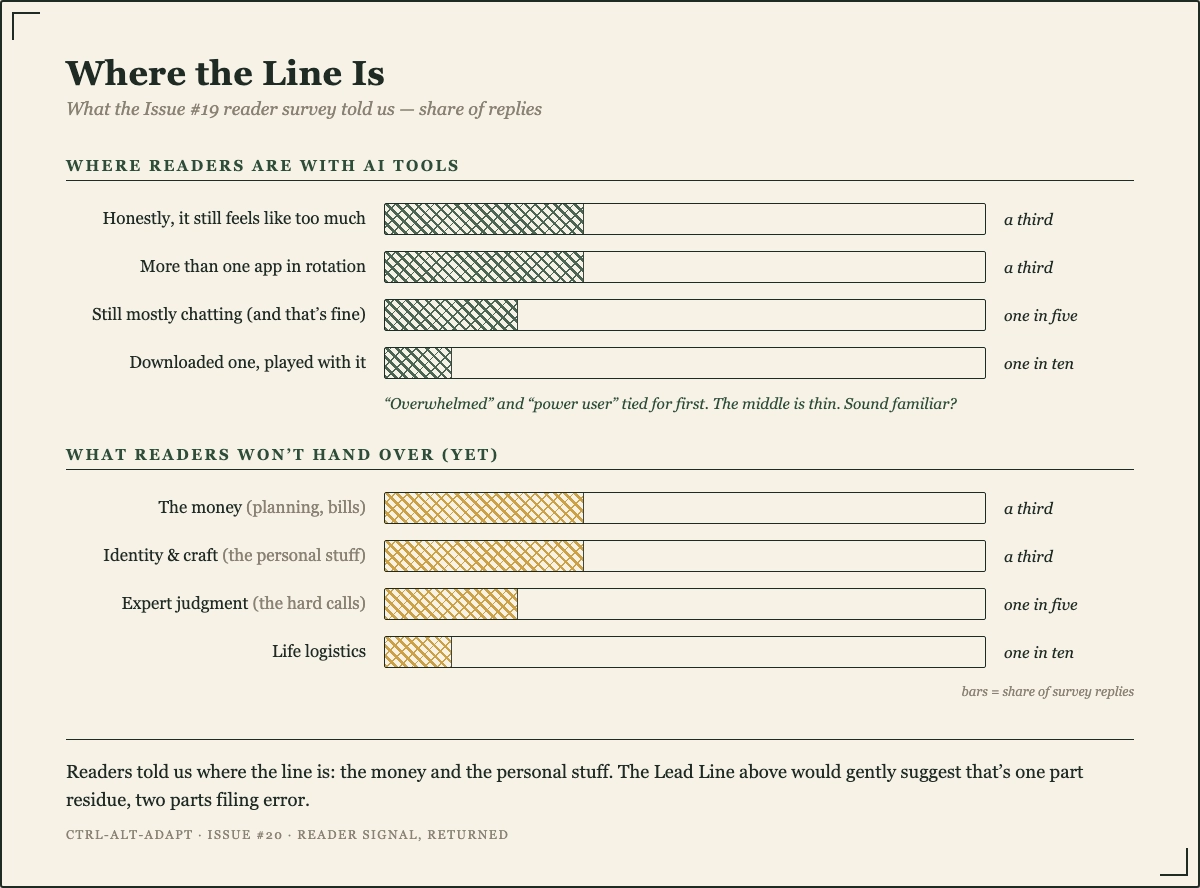
Reader Signal:
When you hold back from AI, which is it really?
Thanks for reading,
-Ep
Miss any past issues? Find them here: CTRL-ALT-ADAPT Archive
Know someone disappointed they didn’t get a miracle? Forward this. Help them recalibrate their expectations.
Did this newsletter find you? If you liked what you read and want to join the conversation, CTRL-ALT-ADAPT is a weekly newsletter for experienced professionals navigating AI without the hype. Subscribe here —>latchkey.ai