| LatchKey.ai | Archive | About | Consulting | Forward |

Issue #12: The Form Is The Function
click to view full-size
The Tape
In one of my earlier working lives, among my most consistent revenue streams for a period of time was digitizing people's VHS tapes and audio cassettes once the technology allowed. They couldn't wait to secure those old memories before the analog media turned to dust. They'd bring in boxes of them: family vacations, first steps, wedding receptions, graduation parties. Recorded on tape. Paid good money to have them saved before the format took everything with it when it went. Because analog is fragile.
But the enemy of analog media isn't just time. It's also transfer. Every time you dubbed a VHS tape you lost something. The fourth generation of a home video looked like a watercolor of the original. Soft edges. Audio that sounded like it was coming from another room. Memories fading before your eyes. Not because the machine was broken. Because that's what analog signal transfer does. Every handoff costs you fidelity. That's not a malfunction.
That's physics.
Now. Think about that last meeting you attended to determine when to schedule the meeting about how many meetings you should be scheduling.
That's physics too.
The organizational coordination layers we've built over the last century of work are an analog system. The handoffs, the hierarchies, the linear calendar slavery, the chain of status updates where information gets compressed and reinterpreted at every station — they all run on the same principle as that fourth-generation VHS dub.
Modern org charts still run on tape.
The Tax
Microsoft put numbers on this recently that were quietly devastating. Across 300,000 employees, they tracked how time actually gets spent: 57% communicating, 43% creating. This wasn't based on a survey of self-reported impressions. This was telemetry. Actual calendar data from over a quarter-million people.
It turns out that “Product Leaders” only spend 5-10% of their week on product vision, and the rest on the coordination choreography of getting everyone on the same page long enough to turn to the next one.
The average knowledge worker now spends roughly 11.3 hours in meetings per week. (Tripled since COVID.)
On some level, we sense this time-suck as overhead. But in daily experience, it's just the job. It feels like work because it is work. It's just not the work.
Review any week on your calendar. At best it shows a romanticized version of your time spent. The events were just the splashes. How far out did each one ripple into the rest of your time? Meeting prep, debriefs, "quick syncs." That gap is a narrative your calendar doesn't participate in.
And that gap confers a steep cumulative cost: between what you are being paid to think and what you actually spend your time doing. It's what Nate Jones calls the coordination tax.
We've just been paying it so long we stopped noticing the line item. It just felt like Tuesday.
The Org
The shape of your org chart is a product of physics too.
Stay with me.
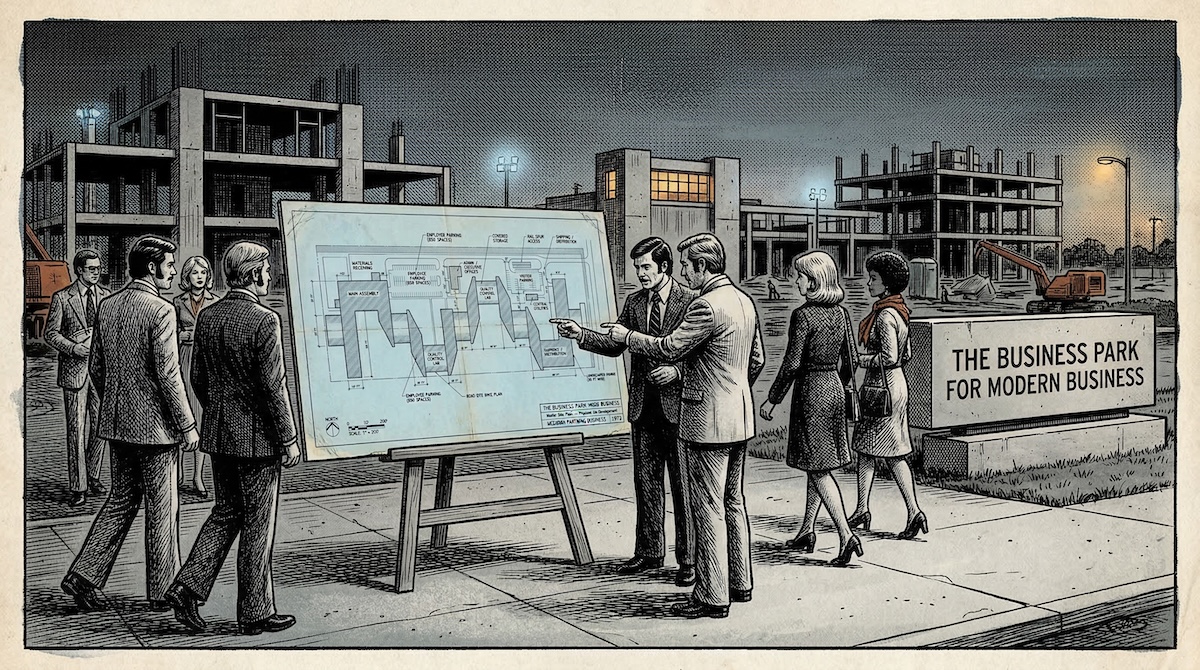
Have you ever seen an engine crankshaft in the wild? Out of context, its shape looks utterly random — until you understand what the shape is solving. Every single throw, counterweight, and journal is exactly where it has to be to meet the design constraint to convert the back-and-forth motion of pistons into rotation at the output shaft, while keeping forces balanced across multiple cylinders firing in sequence.
The crankshaft's shape is the coordination problem made solid. There is no crankshaft that isn't that shape, because there's no other shape that solves that problem.
Now zoom out to see the whole car factory. Its shape was determined by the same thing. To ensure the right material arrives at the right station, in the right condition, at the right moment to build a car as efficiently as possible.
And the org chart hierarchy at work inside — foremen, section leads, floor supervisors — wasn't designed to serve anyone's ego. It, too, takes the form it must to serve the design constraints.
The form is the function.
What AI will do to the workplace is change the form. A new medium, demanding a new shape.
Does that imply a direct threat to jobs? It's hard to see far enough around the corner yet to know for sure. But history may provide some insight here. Jevons Paradox tells us that every time a coordination constraint collapses in favor of innovation — steam power, structural steel, the internet — the total demand for human work doesn't shrink. It explodes into roles nobody could have imagined before the constraints disappeared. Job disruption doesn't automatically mean job destruction.
Usually it just means reconfiguration.
Understanding why your work has the shape it does right now is the best way to understand what it might look like after this transition.

Building a Future of Work That Works (LinkedIn): 52% of all professionals are actively looking for a new role — a historic high. The skills employers are listing have shifted toward AI literacy, human creativity, judgment, and cross-functional collaboration.
Founder Title Surges 60% in Europe as Job Market Shifts (IndexBox / LinkedIn Data): The founder title on LinkedIn is up 60% in Europe as the job market shifts.
Communication Breakdowns in the Operating Room (Greenberg et al., Journal of the American College of Surgeons): 43% of communication breakdowns resulting in injury to surgical patients occurred during handoffs between care providers.
Form Follows Function (Louis Sullivan, 1896): The original articulation: when steel-frame construction eliminated structural constraints, the shape of buildings had to follow purpose, not precedent.
Pull Up Your Calendar — 60% of It Is the Coordination Tax (Nate B. Jones): AI strategist whose coordination tax framework quantifies the overhead: 80 out of every 200 knowledge workers exist primarily to manage handoffs. His calendar audit methodology inspired the Try This exercise.
click to view full-size
The Plan
Most people outside of tech still think that “AI” begins and ends with the chatbot. But looking only at the chatbot is looking at AI through a straw.
The AI that's coming to change the shape of work will arrive as a ubiquitous substrate, not in your browser.
Like indoor plumbing, electricity, the telephone, and the internet. All coordination technologies that changed the shape of work. Invisible once installed, unimaginable to go without soon after.
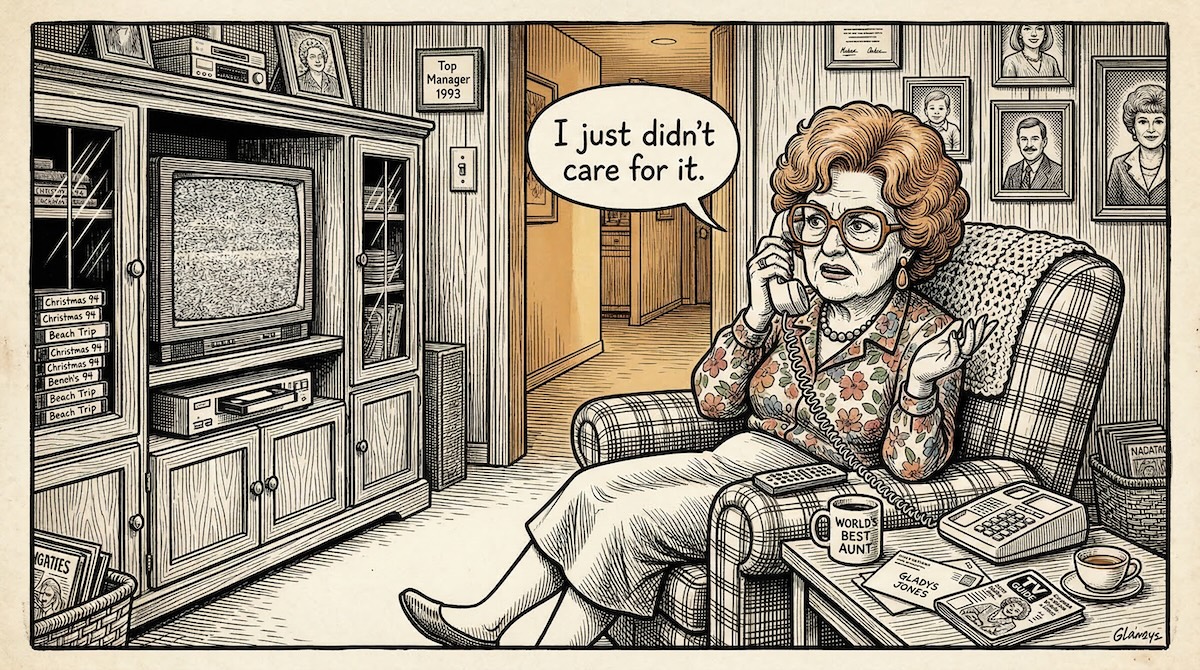
Remember when you would try to explain the internet to your Aunt Gladys in 1998, but she just didn't get it, because she had no mental reference for it? "Think of it like an 'Information Superhighway', Gladys!" Did that work? Did she get it?
Well, you're Aunt Gladys now. Think of AI infrastructure as a new kind of information superhighway, except with something the internet has never had: intelligence. [insert your own joke here]
An information transfer architecture that doesn't just move data — it understands it. What that leap enables is where most people lose the plot.
Today we see whole organizations trying to install AI-shaped capabilities into analog-shaped legacy systems. But that misses the whole point of the technology. It's like buying a Garmin GPS device in 2005 and using it to hold your MapQuest printout on the dashboard while you drive.
The Point
Okay, Ep. So once we pipe this intelligence into the workplace like a utility, then what?
I'm glad you asked, Gladys.
The weekly project status report that currently requires a project manager to spend two hours synthesizing updates from five teams into a compressed version for leadership is, in reality, just a coordination workaround. An AI infrastructure doesn't make the PM faster at writing it. It makes the report unnecessary, because the system already knows the status of every workstream in real time. It knows who needs that knowledge and delivers it to them automatically. What does that mean for the project manager? Are they unnecessary, too? No. It means the PM can spend that time on their actual job: the judgment about what matters, what's at risk, what leadership needs to act on.
AI doesn’t erase the sales and products teams because it tracks both CRM and roadmap data and surfaces what’s relevant all the time for everyone.
It just dissolves the meeting.
Twenty turns of email ping-pong just to schedule a cross-functional review was never a judgment call. It was pure coordination overhead that never required us.
None of this is science fiction. None of it requires a breakthrough. It's infrastructure available right now. You just can't see it from the chatbot.
The Flip
Everyone who grew up with cassette tapes knew the game: get the cleanest copy possible. You went to the source if you could. Or maybe you had a friend with better gear, or at minimum the best copy closest to the original with the least accumulated loss. You didn't dub a dub if you had any other option.
Organizations work exactly the same way. Success in the analog workplace came to those with a gift for moving information through a lossy human relay system with the least degradation. The aptitude to walk into a room full of competing priorities, and walk out with a plan that minimizes signal loss across the organization, is a skill you build a career on. Rightly so. The capability is critical.
The analog medium demands it, and they deliver.
This probably sounds like I’m suggesting managers are an endangered species. That's the wrong way to look at it. Adding AI coordination systems doesn’t remove managers — it makes everyone a manager.
The coordination capability that requires a dedicated specialist to orchestrate across workstreams, track dependencies, and move information with minimal loss, simply becomes distributed infrastructure.
So, it’s not fewer managers. It’s management-as-capability, available to everyone as they engage with the actual work.
But managers aren't the only group who will see the shape of their job change.
Another group has the vision, the domain expertise, the creative insight, the big ideas. But often the type of minds that excel here — the deep thinkers and ideators — get stuck in the gears. Great ideas get drowned out by the relentless din of schedule logistics. Best ideas in the building. Lowest throughput on the org chart.
The coordination tax buried both. The manager's deepest thinking was starved of oxygen by coordination overhead. The ideator’s best work never made it past the lobby.
AI compresses that tax toward zero. Then both groups get something back. The coordinators stop playing Calendar Tetris and start exercising the strategic judgment that was always waiting. The visionaries stop white-knuckling pitch decks through a tide of conference rooms seeking approval, and just start executing.
Nobody was wrong about what they were good at. The shape of the medium changed.
But coordination layers didn’t just cost time. They also hid the imprecise inputs.
After a signal passes through twelve handoffs and arrives degraded, who can say if it was the fault of the system, or if the original input was just weak? Nobody. The nature of analog signal flow provides cover for poor specification at the start.
With AI infrastructure, the camouflage comes off.
When the game of telephone disappears, the fidelity of the original signal starts to matter in a way it never had to before. Because there's nowhere for it to hide.
And this is where a skill most professionals don't realize they've been building becomes the one that matters most. Specification.
There are three distinct levels to good specification skills.
The first level is judgment. To look at something and know whether it's right or wrong, good or bad. Millions of professionals live here. It's valuable. But it's private. It lives entirely inside our heads and doesn’t improve the signal.
The second level is taste. Taste is understanding not just that something is wrong, but why it's wrong. Feeling the gap between what was intended, and what was delivered. More people actually stand here than realize it.
The third level is articulation. And it is the one that's going to separate outcomes. It is the ability to articulate why something is wrong in language precise enough that someone who wasn't in the room could fix it without a single follow-up question.
Level three spans the distance between "I just didn't care for it." and “Here’s what was missing, what was off, and what a better version would do differently.” (Most of us have been on both sides of that feedback. We know which version changes things.)
Fun fact! Almost nobody has trained that third level deliberately. Because we never had to. The noise in the coordination layers absorbed the imprecision. Now the room is getting quieter.
I hope most of you actually feel a little relief at this point. Because the skill that replaces coordination at the top of the org chart is specification. And it turns out to be exactly what AI cannot generate and desperately needs from us. And who has spent decades writing briefs, scoping projects, giving feedback that actually changed outcomes, looking at a deliverable and feeling precisely what was wrong with it and finding the words to make someone else see it, too?
You have.
For thirty years the Background Calculator filed all of that in a row titled "management experience." But it was really specification training.
## 🧭 Try This: The Coordination Audit

Look at last week — work and home. Make two lists.

**List one:** Every task that was pure coordination. Scheduling. Syncing. Following up. Reminding. Aligning. Updating. The meetings that could have been emails that should have been unnecessary.

**List two:** Everything else. The judgment calls. The creative decisions. The relationship moments. The strategic thinking. The work where your experience, taste, and expertise specifically, were the thing that made it work.

Now look at the ratio. How much of the week was the tax — and how much was the job you actually signed up for?

That second list is the shape of the work waiting on the other side. Does it look smaller? Or does it look like the role you always hoped for, but was trapped beneath the tax burden?
Quote to Steal:
"AI makes everyone a manager."
Thanks for reading,
-Ep
Miss any past issues? Find them here: CTRL-ALT-ADAPT Archive
Know someone whose calendar is ninety percent coordination? Forward this. Help them re-coordinate.
Did this newsletter find you? If you liked what you read and want to join the conversation, CTRL-ALT-ADAPT is a weekly newsletter for experienced professionals navigating AI without the hype. Subscribe here —>latchkey.ai