The Bob Problem
click to view full-size
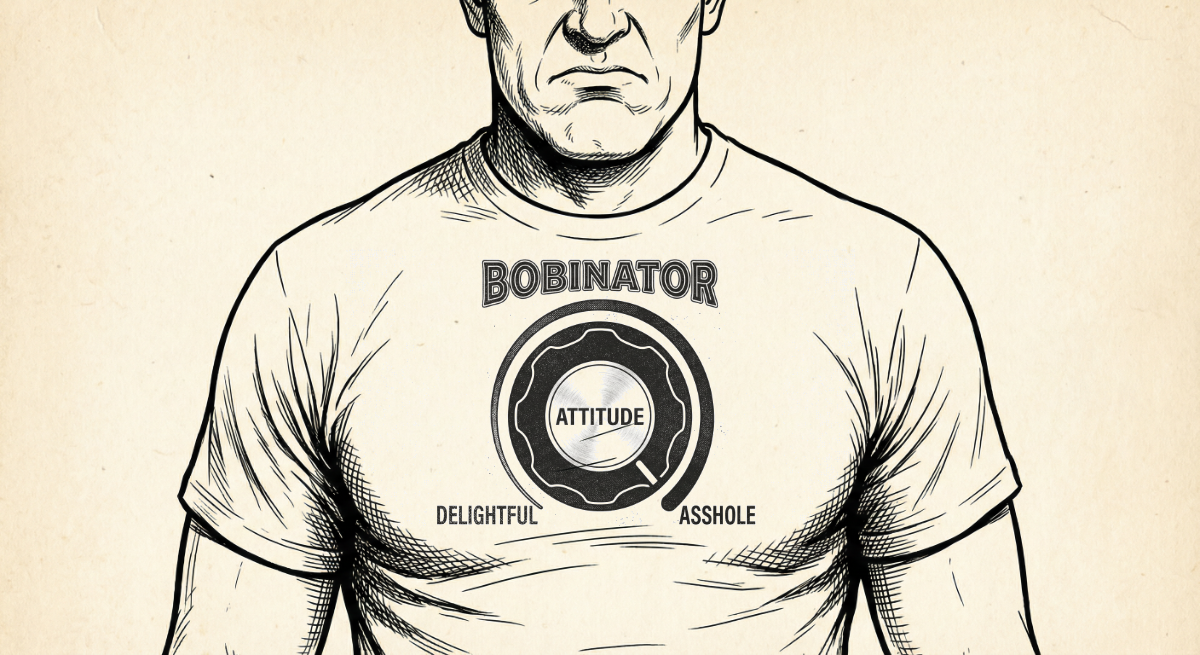
Remember that time you worked on a project with Bob?
You were so excited. You'd heard such great things. So talented. So knowledgeable. Everyone said he was brilliant.
But then the actual interactive experience with Bob… well, it kinda sucked.
Because Bob was an asshole.
He didn’t enjoy doing the work. You didn't enjoy doing the work. You're pretty sure the work itself suffered as a result. The collaboration felt like a grind, not a flow. Every interaction left you slightly drained.
Bob was sour. He needed an attitude adjustment.
But there was nothing you could do about that. Because Bob's a person. He's entitled to his own attitude. His own feelings and disposition. I mean…he’s not a machine!
Although…if he was a machine, you could just - slap - an attitude adjustment switch on it. Or better still, maybe a dial.
Well, guess what?
AI is a machine. And there's a dial.
I’m actually surprised it’s not considered a sexier topic for the AI marketing folks to pitch. What’s sexier than the right attitude?
Ah, but what is the “right” attitude?
If you've used ChatGPT, Claude, or any AI chatbot for more than five minutes, you've probably noticed something: they're aggressively pleasant. "Great question!" “Perfect!” "I'd be happy to help!" "That's a fascinating perspective!"
A great attitude, no doubt. But is it the “right” attitude?
It feels like talking to someone who just really, really wants you to like them.
That's not an accident. It's a setting.
The AI companies ship their models tuned to pure eagerness-to-please. I call this the engagement-optimized default. Or, Factory Flattery. And it makes total sense from their perspective. It’s hospitality.
Who goes on a second date with someone who made them feel bad? Who gives five stars to an app with the conversational energy of a visit to the DMV? Who tells their friends about that dude at work who always goes, “Fffsshhh…really?” whenever you ask them a question?
Cheerful compliance drives downloads, positive reviews, and user retention. The sycophancy isn't a flaw in the AI. It's a business decision.
Understanding this (or not) is one of those inflection points where people either walk away thinking AI is just a yes-machine, or they realize the dial exists, and that it responds. Something shifts. You're not just querying a tool anymore. You're piloting something. The dial becomes a wheel. And suddenly you can see both the ground you've covered, and the broadening horizon ahead.
Who Do You Need In The Room?
AI makes everyone a manager. We covered that in Issue #1. But how best to manage your AI has evolved rapidly. A year ago, the "prompt engineering" crowd was pushing rigid, code-like syntax to keep the AI on task. That era is mostly behind us. Today's models infer intent well enough that conversational clarity beats syntactic precision.
So the AI you're managing will always do its best to follow your process requirements. But things get really interesting when it brings that same energy to your attitude requirements.
Want a constructive skeptic who actually pushes back instead of applauding your mediocre first draft? You can have one. Want a devil's advocate who'll poke holes in your 'brilliant' business idea before your brother-in-law gets a chance to never let you live it down? Just ask.
The AI will comply. Not grudgingly…like Bob. Immediately. Completely.
This is one of the genuine superpowers of simulated intelligence. You can dial in the attitude to serve your actual needs. And it’s in this space where the concept of AI as a ‘thinking partner’ really takes shape.
Role play.
Have the AI play a skeptical version of your target customer. Pitch to it, let it poke holes. Have it interview you about your project like a journalist writing a profile. You'll discover what you actually believe when you have to articulate it. Run a pre-mortem: "Pretend this project failed in six months. Tell me why." You'll learn which risks you are avoiding. Or invoke someone you'd never actually get in the room. "Review this pitch the way Warren Buffett would. What would he pass on, and why?"
Go Ahead and Adjust Your Set
For most users, disposition tuning is a hidden feature. But the controls are pretty straightforward. Like Brightness and Contrast, or Treble and Bass.
Control 1: Model Choice = Your Dispositional Baseline
Different AI models really do have different "personalities" out of the box. Claude vs. GPT vs. Gemini aren't just distinguished by their capability differences, they have temperament differences.
Claude tends toward thoughtfulness, nuance, and epistemic humility. It's more likely to say, "I'm not sure" or "There are multiple perspectives here."
GPT tends toward confident execution and breadth. It's more likely to give you a confident and decisive, but colder, answer and move on.
Gemini tends toward synthesis and connection-making. It's more likely to link your question to adjacent ideas.
And only because I know there must be some asking, “What about Grok?” This may be among the only times I mention it. Because Grok is a hot mess. And here’s one reason why.
These dispositions weren't deliberately designed, they emerged. There's a growing body of qualitative data to suggest that a company's philosophy and culture - its DNA - actually bleeds into its model. Researchers are starting to take notice. It makes sense that Claude's epistemic humility traces to Anthropic's safety-first DNA. GPT's confident decisiveness traces to OpenAI's ship-fast culture. Gemini's synthesis reflex traces to Google's search-and-connect roots. And Grok, well…Grok was born and raised mainly on Twitter/X. You do the math.
Different dispositions for different needs. Choosing your model is choosing your baseline.
Control 2: Instruction Prompts = Tuning the finer frequencies
Once you've picked your model, you can get to the more granular attitude adjustment you want. Software developers figured this out early, that's why CLAUDE.md files and AGENTS.md files have quickly become ubiquitous artifacts in AI coding. Over 60,000 open-source repositories now include files that codify exactly how the AI should behave when working on that codebase.
But you don't need to be a developer to do this. Every major AI platform offers some version of persistent instructions with their base subscription option:
ChatGPT has "Custom Instructions" and "Projects"
Claude has "Claude Projects” with “Knowledge files" and custom system prompts
Google has highly customizable "Gems" for Gemini
These aren't just convenience features. They're a critical layer of AI performance tuning.
click to view full-size
Welcome to the era of personality-based tool selection (The Angle): When choosing your tools became about more than features—it became about fit. "Vibes" and personality are now legitimate factors in tech stack selection.
The Loudness War: Understanding the Battle for Audio Quality (RoEx Audio) : When the music industry optimized for one thing—loudness—it stripped the dynamics from music. Everything started sounding the same. Sound familiar?
What Dario and Sam Actually Disagree About (video) : The two biggest names in AI aren't competing on features. They're building different epistemologies.
The Mac vs. PC Wars, Revisited (Folklore.org) : Remember when software choice was about personality fit, not just specs? The same pattern is emerging with AI models. We're not picking tools. We're picking collaborators.
click to view full-size
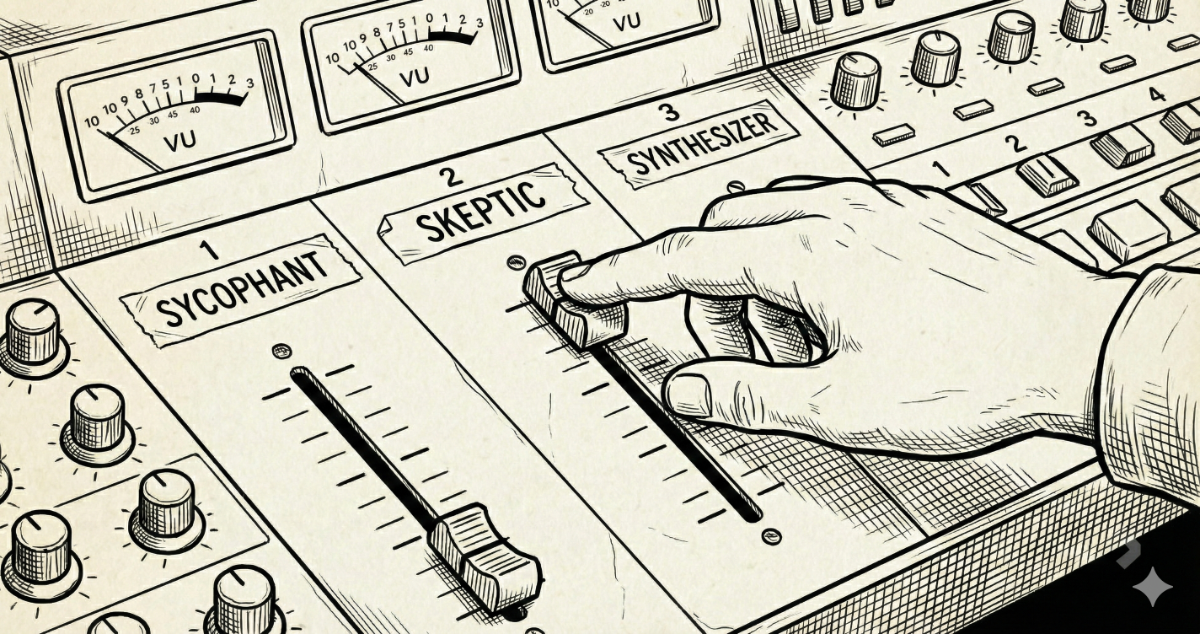
From Solo to Symphony
Let me walk you through four levels of sophistication: from what you can do in a free account right now, to what power users are building.
Track 1: The Scratch Vocal (Your Free Account)
You can shift disposition in a single conversation just by asking.
At work: You're writing a difficult client email about a missed deadline. Instead of just asking AI to draft it, open with: "Help me be direct, but not defensive. If my draft sounds like I'm making excuses, call it out."
At home: You're planning your mom's 83rd birthday. "She loves gardening, sushi, Jazz, hates people making a fuss. Be realistic, I'm one person with two weeks. Pull me back if I overcomplicate this."
This is the simplest form of tuning. You're communicating both the what instructions, and the how instructions to the AI.
Track 2: The Rhythm Track (Subscription)
With any base paid subscription tier (~$20 Mo.) your disposition settings gain significantly more control and can persist across conversations.
At work: You can create a "Board-Prep-Mode" project. Load it up with your strategic priorities, your communication style, and your tendency to over-explain and use too much jargon. Every quarter when the deadline looms, you start there instead of briefing from scratch. It can even reference the prior quarterly reports to ensure continuity where needed and freshness where you can.
At home: Build a "Woodworking Assistant" that knows your skill level, your shop setup (no table saw), and your aesthetic preference (Japanese joinery). It won't frustrate you by suggesting things you can't build.
One of my early AI “ah-ha!” moments came in early 2023. I'm a musician with a lifetime of accumulated gear (including allllmost enough synthesizers) and a bedroom studio that had finally reached critical mass. Everything could wire together into something coherent, if I just had the free time to map out what the hell goes where.
I created a Custom GPT called "Studio Guru" and fed it every PDF manual for every piece of equipment I owned, including new stuff I'd just unboxed. Then I opened ChatGPT on my phone, put it in voice mode, laid down under the desk, and started asking questions out loud. "Which output on the interface goes to which input on the compressor?" "Can I route the aux send through the external effects loop?"
An hour later: up and running. On my own? Instead of a weekend of manual-diving and trial-and-error, I made music. The AI knew my gear because I'd taught it my gear, and explained the way I wanted to work with it.
Track 3: The Session Players (Power User Territory)
This is where CLAUDE.md files, custom knowledge bases, and purpose-built agents live. All things you too can learn to use with natural language. No coding needed.
At work: A "Deal Review" agent loaded with your contract templates, your negotiation principles, and your red flags. It reviews contracts the way you would, because you taught it how you think. It still might get something wrong occasionally, but so does Bob. But the disposition tuning is real, and the wrong attitude can cost you more in the end than an occasional fact-check. (We’ll cover verification habits in a future issue).
At home: A genealogy research agent that knows your family tree, the sources you've already searched, and your verification standards. It doesn't waste time suggesting things you've already tried.
The difference from Track 2? There, you might say "review this like Warren Buffett would" and get a decent impression from training data. At Track 3, you feed it Buffett's shareholder letters, his biography, his investment principles, the deals he passed on and why. Now it's not guessing at the persona. It's channeling it. Oh, and it went and got all that data on Buffett by itself while you were getting a coffee. Because you told it to.
Track 4: The Full Mix (Now You’re Producing)
This is where it gets really interesting. Instead of picking one model, you conduct an ensemble.
In certain working venues, like Notion, you can switch models during a session. Maybe you start with GPT 5.2 to help you get the framework for a contract outlined and check legal compliances. But you switch to Claude Opus 4.5 to draft the actual language, because it excels at tone and nuance, and is far more responsive to your notes. Different model mid-conversation.
The session history transferred. The context survived. But the disposition shifted.
Use one model for heavy structural work, another for voice refinement.
Now you’re managing a team.
That's the top of the ladder. Not "Which AI is best?" but "Which AI is best for this part of this task?"
And emerging data shows that this is the direction serious AI work is heading. A multi-model team. An ensemble you assemble and conduct based on the mood of your work.
Why This Matters For You Now
AI adoption is now matching the pace of the technology itself. And for anyone still ambivalent about the "AI will do your work for you" narrative, remember: it only does the work for you if you don't know what you want. When you do and can articulate it, then it helps you do your work 10x faster.
Here’s what that means for anyone who believes they still have productive years ahead of them.
AI is quickly going to make those who know how to orchestrate it fluently look like they stepped on to one of those moving sidewalks at the airport. Same step pace, but they’re moving much faster, with no perceptible increase in effort.
If you're not ready for that, or even ready to believe it, you should start heading to your gate.
But this is where I remind you that you’ve already solved the most difficult part of that transition.
Because the machine speaks your language. The sidewalk has come to meet you. And it’s listening for your instructions.
## Try This ## The Disposition Comparison

*10 minutes*

You're going to run the same task twice with different disposition prompts. Feel the difference.

**Chat 1: The Cheerleader**

Open your AI tool and start a brainstorm on something you're actually working on. Use this framing:

> "Help me brainstorm ideas for [your topic]. Be encouraging and build on every idea I share."
>

Spend a few minutes going back and forth. Note how it feels.

**Chat 2: The Constructive Skeptic**

New chat. Same topic. Different disposition:

> "Help me brainstorm ideas for [your topic]. Push back on weak ideas, identify potential problems, and help me stress-test my thinking."
>

Same exercise. Note the difference.

**The diagnostic:** Which conversation produced *better* ideas? Which one felt more *productive*? Which disposition actually served your needs?

*The cheerleader probably felt nicer. The skeptic probably helped more. The point is: you get to choose.*
I Want to Know What You're Working On
We're three issues in. You've heard quite a bit from me.
Now I want to hear from you.
Hit reply and tell me:
What are you actually using AI for right now?
What do you want to use it for but don't know how to start?
What are you working on where AI feels like it would be "cheating", or where you just don't see how it could possibly help?
I read every reply. And I’m eager to address your answers in the weeks to come.
Quote to Steal:
"Comparing Claude and ChatGPT is like asking whether a hospital or a television studio is better. They're both buildings. They both use electricity. But they serve entirely different purposes."
Pass the Dial
You know someone who's written off AI as a yes-machine. Maybe they tried it once. Got the Factory Flattery treatment. And decided it was all a gimmick.
Send them this issue. It might help them, and it would help me out as well.
Thanks for reading,
-Ep
Miss any past issues? Find them here: CTRL-ALT-ADAPT Archive
Did this newsletter find you? If you liked what you read and want to join the conversation, CTRL-ALT-ADAPT is a weekly newsletter for experienced professionals navigating AI without the hype. Subscribe here —>latchkey.ai