Using AI is not a technical skill. It’s a communication skill.
click to view full-size
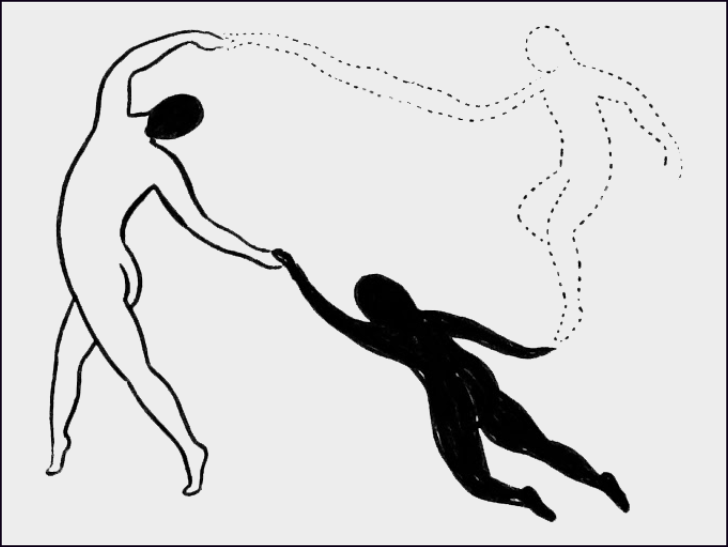
Take a second to consider this. For 300,000 years there has been a deceptively simple dance that goes like this. Language turns ideas into conversation. Conversation creates shared meaning. And for 300,000 years the only partner a human could have in that dance was another human mind. Think of it. Every conversation, every negotiation, every clarification to achieve a shared understanding happened between human minds.
Then, about eighteen months ago, something completely new joined the conversation.
And we're doing what humans always do with something new: we're pattern-matching to what we already know. The human mind naturally reaches for familiar references to understand new experiences. Some people look at AI and see a super fancy autocomplete. Others see a proto-consciousness to fear or worship.
Both are wrong.
AI isn't a tool you operate. It isn't a mind you relate to. It's still computers doing math, only at a scale that makes the output feel like intelligence, even though it isn't.
AI is simulated intelligence the way Google Street View simulates a city. Detailed enough to get the vibe. Still can’t meet the neighbors.
After eons our brains are wired to treat intelligence as consciousness. That’s why AI feels so strange. It triggers reflexes in our brains that are as old as time, but now those reflexes just don’t compute. That creates the cognitive dissonance, cultural confusion and fear we see today.
But intelligence isn't consciousness.
Think of it this way: over the last 40 years computing evolved from spreadsheets to AI the way television evolved from 4:3 standard def to 8K immersive VR. The fidelity is now so high it feels almost real. But 8K VR, no matter how lifelike, doesn’t become actual 3D objects in meatspace that you can touch. Higher resolution doesn't change the category.
AI is the same. It's an extraordinarily high-resolution simulation of linguistic pattern matching, but at the end of the day it's still just math. Blazing fast math. Not a mind on the verge of waking up.
Yet, the simulation is now so convincing that the distinction hardly matters. It doesn't need to wake up to change the world. It just needs to listen. It's the first non-human partner in the dance. And it is forcing a fundamental evolution in our relationship to language, ideas, and conversation. The place where shared meaning and understanding is curated.
Functionally, it turns the computer into a communication partner that responds directly to language. Instead of mapping key commands to features, proficiency is now defined by how clearly you can map intent into words.
This is why the tech industry struggles to explain it. They are obsessed with measuring keystrokes, token speeds, and benchmarks. They are using computer science metrics to quantify a liberal arts product. They should be measuring clarity and intent. Because with AI, the skill that matters most isn't learning the interface. It's knowing what you want before you ask.
click to view full-size
The Trust Paradox: Stack Overflow's 2025 survey (report) reveals a telling split. More developers using AI tools, but trust in those tools is falling. The honeymoon's over; now comes the real relationship.
The Sanity Check: Anil Dash, cutting through the noise (podcast): "Settle down, nerds. AI is a normal technology." Not magic. Not apocalypse. A tool that amplifies whoever wields it.
The Fog Problem: Harvard Business Review (article) on why strategy fails: "The language of strategy becomes more fog than fuel." When the interface is words, clarity becomes operational horsepower, with or without AI.
The Infinite Inbox: Microsoft's Work Trend Index (report): 40% of employees check email before 6 a.m. The average worker fields 117 emails and 153 Teams messages daily. Communication became frictionless. Expectations quietly grew. Sound familiar?
The Primary Source: Steve Jobs at Aspen, 1983 (video): The full speech that inspired "You've Been Here Before." Forty minutes of a young Jobs explaining computers to designers, and predicting exactly where we are now.
You’ve been here before.
click to view full-size
Aspen, Colorado. 1983.
Steve Jobs is standing in front of a room full of designers, executives, and curious onlookers at the International Design Conference. He asks how many of them own a personal computer.
Almost nobody raises their hand.
This is the design conference. Unbeknownst to the crowd in that moment, they are the people who will go on to shape not only how computers look, feel, and function for the next forty years, they will be among the core job categories to benefit most from the revolution about to unfold. And in 1983, they don't even have a computer. They barely understand what one is.
So Jobs explains.
"Computers are really dumb," he tells them. "They're exceptionally simple, but they're really fast."
He describes the instructions a microprocessor actually executes: get a number from here, add two numbers together, check if it's bigger than zero, put it over there. The most mundane, trivial operations you could imagine.
Then he offers an analogy.
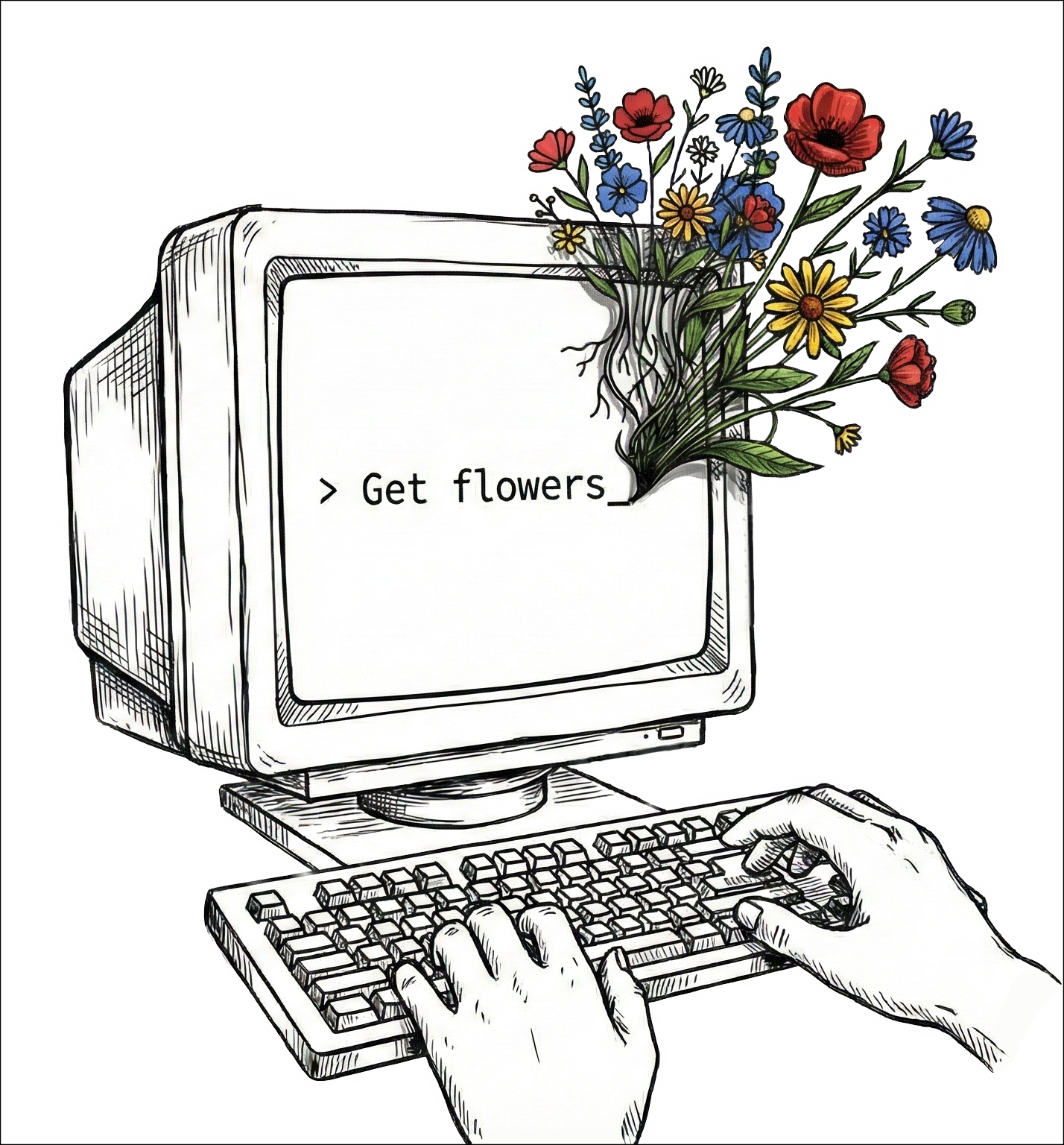
"Let's say I could move 100 times faster than anyone in here. In the blink of your eye, I could run out there and grab a bouquet of fresh spring flowers and run back in here and snap my fingers, and you would all think I was a magician."
But it wouldn't be magic. The trick is the speed.
"It's the exact same way with the computer," Jobs says. "It can go grab these numbers and add them together and throw them over here at the rate of about a million instructions per second. And so we tend to think there's something magical going on when in reality there's just a series of these simple instructions."
Sound familiar?
Forty years later, we're doing the same thing with AI. Watching it produce something that feels like intelligence and assuming the magic is in the thinking. But it isn't. The magic is still in the speed. It's pattern-matching at a scale so vast that the output feels like understanding, even though it's just math, moving very fast.
But Jobs didn't stop there. He described the journey that was already underway:
"Instead of saying, 'Turn right, left foot, right foot, left foot, right foot, extend hand, grab flowers, run back', I can say, 'Could you go get some flowers?' And we have started in the last 20 years to deal with computers in higher and higher levels of abstraction."
He saw where this was going. The instructions would get simpler. The interface would rise. And eventually—eventually—we'd stop speaking to the machine in its language and start speaking to it in ours.
That moment arrived about eighteen months ago.
The interface is now just... language. The same language you use to ask a colleague for help. The same language you use to explain what you need. The abstraction Jobs described finally reached human conversation. And today, the more effectively you can put the words together, the more powerful you can be at your computer.
Which brings us back to the beginning: AI is not a technical skill. It's a communication skill. And conversation is the new code.
This is what higher abstraction actually buys you. Not a machine that thinks for you, but one that finally keeps up with how you already think.
Jobs closed his 1983 talk with this: "We have an opportunity to do it great, or to do it so-so."
This newsletter exists to help you do it great.
Welcome to CTRL-ALT-ADAPT. If any of this got you thinking, I’d love to hear from you. This is a conversation we’re in together.
Thanks,
-Ep
## Try This

Don't overthink your next AI conversation. Pick something you already know well. A hobby, a side project, a topic you could explain to a stranger at a party. Open ChatGPT, Claude, Gemini, whatever you have access to. And just... explain it. Not to get an answer. To see what happens when you talk to something that actually interprets your meaning.

End your explanation by asking the AI to reflect back its understanding of the topic based on what you provided. What gaps does it reveal in your own clarity?

That's the on-ramp. Start where you're already fluent. The productivity comes later.
Know someone struggling to grasp AI? Forward this. They might appreciate the perspective.
Did this newsletter find you? If you liked what you read and want to join the conversation, CTRL-ALT-ADAPT is a weekly newsletter for experienced professionals navigating AI without the hype. Subscribe here —>latchkey.ai